
Transferability & Owner Dependency
Business Exit Readiness Checklist: Prepare a Transferable Company in 2026
What if the best measure of exit readiness isn’t how soon you plan to transition, but whether the business can thrive without you? That’s the question behind a practical business exit readiness checklist.
It’s natural to focus on timing, potential value, or who might take over. Readiness starts with the company itself: whether decisions, key relationships, and daily operations can continue without the owner, and whether financial information is timely enough to support sound planning.
This checklist helps you identify gaps in owner dependency, financial clarity, and transition assumptions. Use it to prioritize practical next steps, not to decide whether to pursue a transaction. The information is general and isn’t advice for a specific business.
41 Legacy helps owner-operated companies develop a clearer financial picture through its fixed, six-week financial clarity intensive and ongoing CFO Seat. The work focuses on financial decisions through a dual lens: their profit and cash impact, and their enterprise-value impact. The aim is to help owners build a more transferable company, not simply prepare for a future handoff.
Key Takeaways
- A business exit readiness checklist helps you assess whether the company can transfer with less reliance on its owner, before choosing a transition date or path.
- Use evidence prompts to examine financial clarity, operational continuity, and key relationships. Look for gaps rather than relying on unsupported benchmarks or pass marks.
- “Three weeks late is how old the average owner’s financial picture is when the decision has to be made”. Treat this as general information and examine how timely financial insight supports your decisions.
- Seller financing means receiving some payment over time. Consider how delayed payments and the possibility of default could affect your financial picture.
- Turn findings into action: document the current state, identify gaps, rank dependencies, assign responsibility, and revisit progress.
Business Exit Readiness Checklist: What Readiness Actually Measures
Readiness is the company’s ability to transfer with less reliance on its owner. It reflects whether the business can sustain financial visibility, customer and supplier relationships, decision-making, and daily operations if the owner steps back. A business exit readiness checklist is a diagnostic tool, not a declaration that the company is ready to exit.
Assessing readiness is useful before choosing a transition date or path. It’s distinct from a completed exit plan, a valuation, or a transaction. Exit planning can address enterprise value and an owner’s non-financial objectives, as described in What is Business Exit Planning? A readiness review gives the owner a clearer view of the company’s current condition before deciding what, if anything, to pursue.
What does an exit readiness checklist assess?
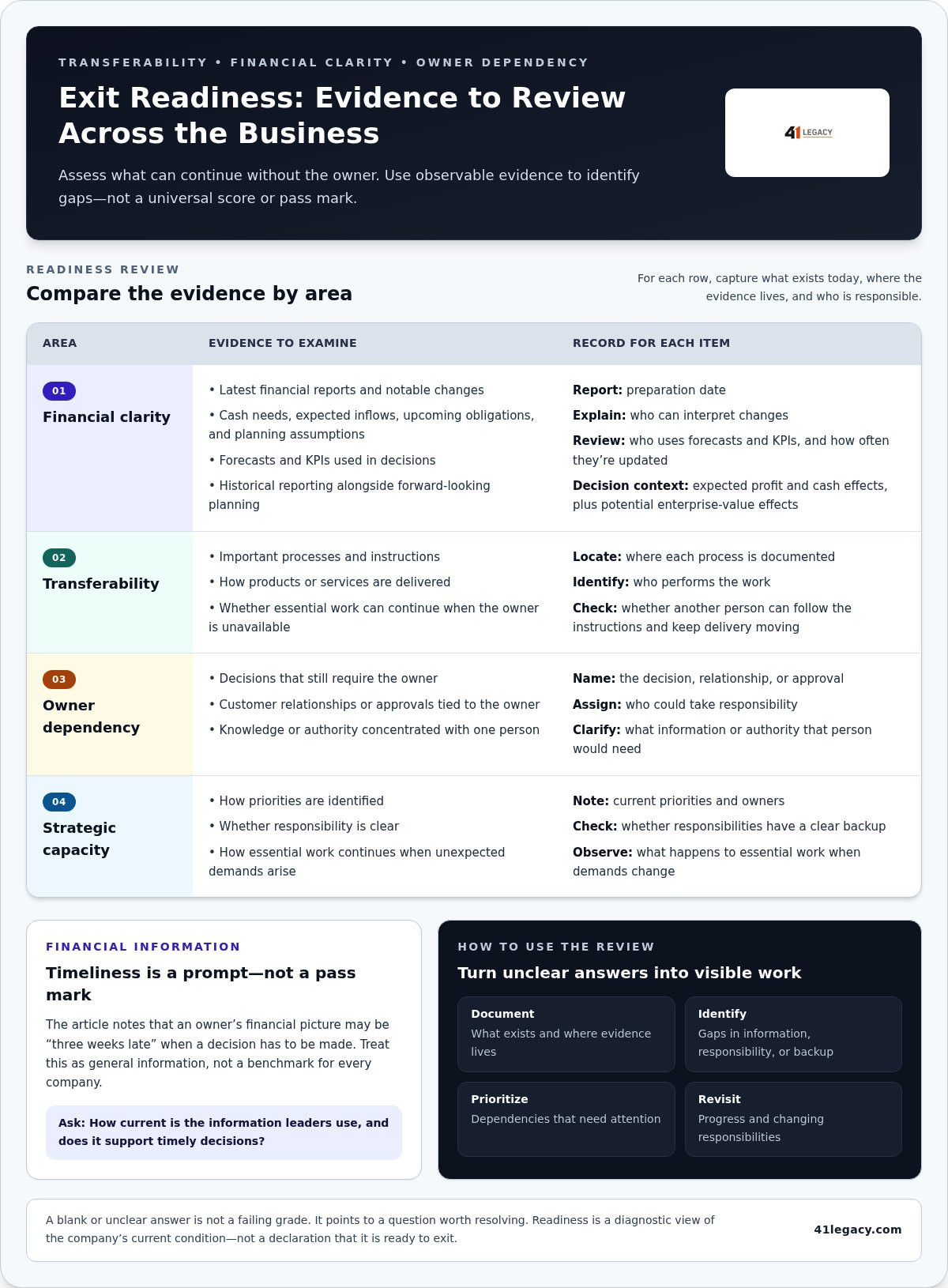
Look for observable evidence across four connected areas. The aim isn’t to assign a universal score. It’s to identify where the company relies on informal knowledge, unclear responsibilities, or incomplete information.
- Financial clarity: Can leaders review timely, consistent reports and understand what is driving cash flow, profit, and major changes?
- Transferability: Are important processes documented, and can someone other than the owner follow them to deliver the company’s products or services?
- Owner dependency: Which decisions, customer relationships, or approvals still require the owner? Who could take responsibility, and what information or authority would they need?
- Strategic capacity: Can the company identify priorities, assign responsibility, and keep essential work moving when unexpected demands arise?
Use evidence prompts rather than pass-or-fail marks. For each critical process, note where instructions are recorded, who performs the work, and whether it continues when the owner is unavailable. Record which reports inform decisions and how regularly leaders review them. The gaps that matter will differ by company, owner goals, and possible transition path. As general information, “80 to 90 % of an owner’s net worth sits inside the business”. This isn’t advice for a specific business; each owner’s circumstances and priorities are different.
Why assess readiness before choosing an exit date?
Early assessment creates time to address weaknesses in an orderly way, without promising a particular outcome. It can reveal where knowledge is concentrated, reporting needs attention, or responsibilities have no clear backup. Those findings give the owner a basis for setting priorities while there’s time to build stronger habits.
The benefits extend beyond a future transition. Documented processes and clear reporting can help the company respond to ordinary decisions, such as managing a change in demand or weighing a new operating priority. Better visibility helps leaders understand the financial and operational context before acting. Clearer responsibility helps work continue without every decision returning to the founder.
Preparation doesn’t require an immediate sale or a predetermined transition structure. It’s an ongoing discipline for strengthening a company’s ability to operate beyond its owner. This section provides general information, not advice for a specific business. The scope of each engagement is defined in the client’s written agreement.
Exit Readiness Checklist for Transferability, Financial Clarity, and Owner Dependency
Use this business exit readiness checklist to record what exists today, where the evidence lives, and who is responsible. A blank or unclear answer isn’t a failing grade. It points to a question worth resolving. This checklist offers general information, not advice for a specific business.
Financial clarity and enterprise-value visibility
Separate historical reporting, which shows what has happened, from forward-looking planning, which helps owners consider what may lie ahead. Review whether both inform timely decisions. The right measures will vary by company, so focus on the reports and practices your leaders actually use.
- Reporting: Identify the latest financial reports, their preparation date, and who can explain notable changes.
- Cash visibility: Note how leaders review cash needs and expected inflows. Record whether they can see upcoming obligations and the assumptions behind their plans.
- Forecasts and KPIs: List the forecasts and key performance indicators (KPIs) used in decisions, who reviews them, and how often they’re updated.
- Decision context: For a recent major decision, record the expected profit and cash effects alongside the potential effect on enterprise value. This dual-lens evaluation helps leaders see more than near-term earnings alone.
“Three weeks late is how old the average owner’s financial picture is when the decision has to be made”. Use this general-information statement as a prompt to examine the timeliness of your own information, not as a benchmark for every company. 41 Legacy’s fixed, six-week financial clarity intensive includes one working session per week. Weeks 1 and 6 are identical for every client, weeks 2-5 are customized after week 1, and the week 3 deliverable is a 13-week cash-flow forecast.
Transferability and owner-dependency signals
Trace how work and decisions move through the company. Identify reliance on one person and the records or responsibilities that could help others carry essential work forward.
- Key relationships: Note who manages important customer and supplier relationships, where relevant history is recorded, and who else can access it.
- Decision rights: List recurring decisions that require the owner’s approval. Record who could take responsibility and what authority or information they would need.
- Operating routines: Identify essential processes, their written instructions, and the employees who can perform them without the owner’s direction.
- Coverage: For each critical role, name the designated backup, if one exists, and document where handoffs or knowledge gaps remain.
Reducing owner dependency can support continuity, but it doesn’t guarantee a particular transition. The value lies in making responsibilities and knowledge visible, then deciding which gaps deserve attention. For a structured approach to financial visibility, explore 41 Legacy’s approach to financial clarity. The scope of each engagement is defined in the client’s written agreement.
Seller-Financing Risks to Include in an Exit Readiness Checklist
Seller financing is a transaction structure where the seller receives some payment over time instead of receiving the full amount at once. It can affect the owner’s future cash picture, but it doesn’t resolve the company’s underlying readiness gaps. Include it in a business exit readiness checklist as a planning consideration, not as a decision about which structure to choose.
What seller-financing assumptions should an owner examine?
Start with how delayed payments could affect your financial picture and transition objectives. Then consider whether company forecasts show how expected cash needs could change under different scenarios. For example, compare expected receipts with a scenario in which payments arrive later or operating needs shift. The purpose is to understand exposure, not predict a particular outcome.
Keep general planning questions separate from the specific payment terms and conditions set out in a written transaction agreement. This checklist can help you identify issues to consider, but it doesn’t determine whether a particular arrangement is appropriate.
Readiness area | Questions to examine
Owner’s financial picture | How would receiving part of the payment over time affect your available resources and transition priorities? What assumptions are you making about the timing of those payments?
Company cash needs | Do forecasts make expected cash needs visible across different operating scenarios? Which assumptions would need updating if timing or business conditions changed?
Continuity of operations | Can the company continue to serve customers and manage its obligations without relying on the owner to resolve routine issues?
Relationships and dependency | Are customer relationships concentrated around the owner? Is important relationship history recorded and accessible to others responsible for continuity?
How does seller financing compare with other readiness considerations?
A financing assumption addresses how payment might be received. Transferability depends on broader evidence: the company’s operations, relationships, financial visibility, and ability to function with less owner involvement. Treat these as distinct dimensions rather than assuming one can compensate for another.
Consideration | What it reveals
Seller-financing assumptions | Whether delayed payment expectations fit the owner’s financial picture and transition objectives.
Operational continuity | Whether essential work can continue through documented routines and clear responsibilities.
Customer concentration | Whether important revenue and relationship knowledge depend heavily on a limited number of customers or on the owner personally.
Owner dependency | Which decisions, approvals, or relationships still require the owner’s direct involvement.
No financing structure, by itself, makes a company transferable or its financial information clear. Use these questions to surface assumptions and distinguish financial planning from operational readiness. This is general information, not legal, tax, or investment advice, and not a recommendation for a specific transaction.
Using an Exit Readiness Checklist to Prioritize Next Steps
A checklist becomes useful when observations lead to clear action. The aim isn’t to fix every gap at once or achieve a universal readiness score. Identify which issues most affect cash clarity, operational continuity, and the company’s ability to function with less reliance on its owner.
Turn checklist observations into a short priority list
Move from evidence to action in a deliberate sequence. Keep the record concise enough to revisit, but specific enough that another leader can understand why a gap matters.
- Document the current state. Describe what happens today and point to supporting evidence, such as a report, written procedure, role description, or recurring meeting practice.
- Identify the gap. State what’s missing or unclear. For example, a forecast may exist, but its assumptions may not be recorded or reviewed with the people responsible for decisions.
- Rank dependencies. Consider the effect of each gap on cash visibility, continuity of essential work, and transferability. A process known only by the owner may deserve attention if its interruption would affect customers or revenue.
- Assign responsibility. Give someone inside the company responsibility for the next step, along with a realistic milestone. That could mean documenting a procedure, clarifying approval authority, or establishing a regular review of forecast assumptions.
- Revisit progress. Record what changed, what evidence now exists, and what remains unresolved. Adjust priorities as circumstances develop.
Separate immediate information gaps from longer-term operating or leadership improvements. If leaders can’t see upcoming cash needs clearly, improving the underlying information may be an early priority. If essential work depends on one person, documenting the process and establishing clear responsibility may take sustained attention. Keep the evidence beside each item so the ranking is practical and reviewable, not based on instinct alone.
Revisit readiness as the business changes
Readiness isn’t fixed. Review the checklist when strategy, leadership, cash needs, or owner plans materially change. A new growth priority may put pressure on working capital; a leadership change may expose a process that was never documented. Rechecking the evidence helps owners respond to the company as it is now, not as it was at the last review.
Use the review to inform forward-looking decisions as well as understand past results. Ask what upcoming commitments, capacity needs, or leadership responsibilities could affect the next period, and what evidence supports those assumptions. The right review rhythm depends on the company’s circumstances; a fixed timeline or score would create false precision.
These checklist answers are general planning inputs, not advice for a specific business. For support connecting financial clarity to practical priorities, see how 41 Legacy supports financial clarity.
How 41 Legacy’s Financial Clarity Intensive Supports Exit Readiness
A business exit readiness checklist can surface questions that need a closer look at the company’s financial information and decision practices. 41 Legacy’s fixed, six-week financial clarity intensive provides a structured diagnostic to help owners examine those areas and identify priorities. It offers a clearer financial picture, not a guarantee of readiness or a particular transition outcome.
What the financial clarity intensive establishes
The intensive includes one working session per week, weekly deliverables, and a custom KPI tracking sheet. Weeks 1 and 6 are identical for every client. Weeks 2-5 are customized after week 1, and the week 3 deliverable is a 13-week cash-flow forecast. This structure helps owners bring relevant financial measures into view and assess how they inform business decisions.
For owners seeking continued financial perspective, the monthly CFO Seat supports budgeting, forecasting, KPI review, decision support, working-capital discipline, and enterprise-value tracking. It focuses on forward-looking strategic finance, evaluating each financial decision through a dual lens: profit and cash impact, and enterprise-value impact. It doesn’t replace a bookkeeper or controller and doesn’t include operational accounting tasks.
What to expect when exploring a 41 Legacy engagement
41 Legacy serves owner-operated companies with $1 M to $30 M in annual revenue. The first contact is a 30-minute conversation: “No pitch. No pressure.” It’s an opportunity to discuss the owner’s priorities and consider whether structured financial work fits the questions at hand.
Information on the website is general and isn’t advice for a specific business. 41 Legacy isn’t a CPA firm and doesn’t provide audit, review, or other attest services, legal advice, or investment advice. The scope of each engagement is defined in the client’s written agreement, which sets out the work and expectations for that engagement.
If you’re ready to explore your company’s financial priorities, start with a 30-minute conversation. No pitch. No pressure.
Build Transferability One Deliberate Step at a Time
The most useful next move may be smaller than a full transition plan. Choose one readiness gap that affects the company’s ability to make decisions or keep essential work moving. Define the evidence that would show progress, identify who inside the business can advance it, and set a point to review what has changed.
That approach keeps a business exit readiness checklist connected to the company’s ongoing health, rather than treating it as a document to complete and file away. As priorities shift, revisit the assumptions behind the work. A company that grows less dependent on its owner is better positioned to adapt, whether a transition is near or still years away.
Each owner’s starting point and goals are different. A focused conversation can help clarify which readiness questions deserve attention first and how structured financial support may fit. Discuss your company’s readiness priorities with 41 Legacy, and take the next step toward a business built to thrive beyond its founder.
Frequently Asked Questions
Can a business be exit-ready if its owner has no planned exit date?
Yes. A business exit readiness checklist can help an owner strengthen the company before deciding when or how to transition. For example, documenting how pricing decisions are made or ensuring another leader can handle a key customer issue may improve day-to-day resilience now. These steps don’t commit the owner to an exit. They help preserve options as the business and the owner’s goals evolve.
Does an exit readiness checklist apply to an internal transition?
Yes. It can help prepare the company for a transition to a family member, employee, or existing leadership team. Consider whether the next leader has access to the operating knowledge, decision authority, and financial context needed for the role. An owner might begin by identifying recurring decisions they handle personally, then record which could be delegated and what support the successor would need.
How often should an owner revisit an exit readiness checklist?
There’s no universal review schedule. Revisit it when a meaningful change could make previous answers outdated, such as a leadership shift, a new growth direction, a change in customer mix, or revised owner priorities. At each review, update the evidence and note who is responsible for any open item. This keeps the checklist useful for decisions rather than turning it into a static document.
What financial information is useful when assessing exit readiness?
Useful information includes recent financial statements, cash-flow forecasts, and the key performance indicators leaders use to track the business. Look at whether reports explain unusual changes and whether forecast assumptions reflect expected commitments and cash timing. Compare plans with actual results to see where assumptions may need attention. The aim is a clearer basis for decisions, not a valuation conclusion or advice for a specific company.
Does seller financing automatically mean the seller stays involved?
No. Receiving some payment over time doesn’t, by itself, determine whether the former owner continues working in the business. Payment arrangements and expectations about any ongoing role are separate questions. An owner can prepare by listing the knowledge, relationships, or responsibilities that might require a handoff, then note which transition expectations need to be addressed in the written transaction agreement.
Does completing a checklist provide a certified business valuation?
No. A checklist can organize information about financial visibility, responsibilities, and operational dependencies, but completing it doesn’t establish a certified business valuation. It may help an owner identify questions or records that need further consideration. Treat checklist findings as general planning information, not as a formal valuation, a promised estimate of value, or advice about a particular transaction.
Can an exit readiness checklist guarantee a successful business transition?
No. A checklist can surface risks and help owners plan practical improvements, but it can’t control every factor that may affect a transition. Use it to test continuity: could another person find the information needed to handle a key decision, maintain a customer relationship, or respond to a cash-flow change? Addressing gaps can strengthen preparedness, but it can’t promise a specific result.
Disclaimer
This article is for educational and informational purposes only and does not provide legal, tax, investment, or business brokerage advice. 41 Legacy does not offer M&A brokerage services, legal document drafting, tax preparation, or investment advisory services. Business owners should consult licensed professionals in those disciplines before making decisions related to business transactions, legal matters, tax strategy, or financial planning. All examples are illustrative and may not apply to your specific situation.