
Transferability & Owner Dependency
Beyond the Transaction: Navigating Common Business Sale Pitfalls Through Strategic Readiness
A business that cannot thrive without its founder is not an asset. It's a high-stakes obligation. While you've spent years acting as the guardian of your company's history and performance, the reality is that many owners find themselves trapped by their own excellence. When the time comes to transition, they frequently encounter common business sale pitfalls that reveal a painful "Value Gap" between their expectations and the market's appraisal. This gap usually stems from an enterprise that's too dependent on its creator, functioning more like a personal job than a transferable legacy.
We understand the weight of this realization. You deserve to see your life's work preserved and elevated, rather than diminished by a lack of strategic readiness. In the following passages, you'll discover how to identify the hidden vulnerabilities that prevent successful transfers. We'll examine the shift from a transactional mindset to one of enterprise transferability, ensuring your advisory team works with the precision of master artisans. By the end, you'll have a clear roadmap for building a business that stands as a testament to your vision, independent and enduring.
Key Takeaways
- Understand how to bridge the "Value Gap" by shifting your focus from historical earnings to the objective market reality of enterprise transferability.
- Learn to identify common business sale pitfalls, such as the "Rainmaker Trap," where founder dependency inadvertently erodes the enterprise value you've spent years building.
- Recognize the importance of coordinating your professional advisors under a single strategic vision to eliminate silos and ensure a unified path toward your goals.
- Discover how to move beyond basic financial reporting to prove operational maturity, ensuring your business is viewed as a high-performance asset rather than a job.
- Gain clarity on how a Value Growth Roadmap serves as the definitive blueprint for increasing the intrinsic value and long-term health of your enterprise.
The Illusion of Readiness: Why Most Business Sales Fail Before They Begin
The belief that a successful business is inherently a transferable one remains a frequent misconception. It's a quiet tragedy when a founder, after decades of meticulous stewardship, discovers their enterprise isn't ready for a new hand at the helm. This realization often arrives far too late. Within the complex landscape of Mergers and acquisitions (M&A), the most significant failures don't happen at the negotiating table. They happen years prior, rooted in a lack of strategic alignment. These common business sale pitfalls often center on the "Value Gap," which is the stark difference between what an owner needs for their next chapter and what the market is actually willing to pay for the current state of the company.
Entering the market without a structured plan is often called a "toe-in-the-water" approach. It's a perilous strategy. When an owner engages potential buyers without a formal Exit Readiness Assessment, they often reveal operational cracks that buyers use to drive down the price. This lack of preparation doesn't just lower the valuation. It can damage the brand's reputation in the eyes of the professional community. True readiness is not a feeling. It's a verified state of enterprise maturity that requires an uncompromising eye for detail.
The Distinction Between Profitability and Transferability
Profit is a reflection of the past. Transferability is a promise of the future. A buyer isn't paying for what you achieved; they're paying for the confidence that those achievements will continue without your daily presence. Many profitable firms fail this test because their success is tied to the founder's intuition rather than documented systems. We call this a lack of Asset Maturity. Without clear engineering of the business's internal essence, even high earnings are discounted by sophisticated buyers. Precision in documentation is the differentiator between a job and a transferable asset.
Identifying the Value Gap Early
Strategic clarity begins with an honest look at the numbers. The Value Gap is often comprised of two distinct parts. First, there's the wealth gap, which is the shortfall in personal net worth needed to maintain your lifestyle after the sale. Second, there's the value gap, the difference between your business's current value and its potential value if it were optimized for transfer. We utilize Enterprise Diagnostics to establish this baseline early. Waiting until the transaction phase to address these leaks is a costly error. By identifying these gaps now, we can engineer a roadmap that bridges the distance between market reality and your ultimate legacy goals.
The Rainmaker Trap: How Owner Dependency Erodes Enterprise Value
A business that requires its founder's constant attention is a delicate instrument, not a resilient enterprise. Many owners take pride in being the primary driver of their company's growth, acting as the lead architect for every sale and the sole guardian of every key client relationship. This individual excellence, while foundational in the early years, eventually becomes a magnetic pull that keeps the business tethered to the individual. Navigating common business sale pitfalls requires a cold, objective assessment of how much the enterprise relies on your personal talent versus its internal systems.
When sophisticated buyers observe that the owner is the sole "Rainmaker," they see a fragile ecosystem rather than a transferable asset. If a business cannot survive a 30 day founder absence without a decline in performance, its value is significantly discounted. This aligns with broader research into common M&A pitfalls, where the failure to institutionalize knowledge and relationships leads to significant value decay after a transaction. True enterprise value is found in the silence that follows your departure, not in the noise of your daily involvement.
The Risk of the Indispensable Founder
Owner dependency is the primary friction to a successful transfer. When you are the indispensable engine of the company, you create a "Key Person Risk" that sophisticated investors find unacceptable. The psychological hurdle for many founders is shifting from the role of the master artisan who "does" the work to the curatorial leader who "stewards" the system. Without this transition, the business remains a personal practice rather than a scalable entity that can thrive under new ownership.
Strategies for Owner Dependency Reduction
The path to a premium valuation involves a deliberate shift from founder-led to system-led growth. This begins with a Strategic Capacity Evaluation to determine if your second-tier management is prepared to lead without your intervention. By empowering a leadership team and decentralizing decision-making, you transform the business into a turnkey asset. This process of transferability engineering ensures that the essence of the company is preserved in its processes, making it an irresistible opportunity for those seeking a mature, independent enterprise.
- Empowerment: Transition daily operational authority to a capable management tier.
- Documentation: Codify your unique "Rainmaker" intuition into repeatable sales systems.
- Autonomy: Test the business with increasing periods of founder absence to identify remaining dependencies.
The Fragmented Advisory Pitfall: Why Your CPA and Attorney Need a Quarterback
A masterpiece is never the result of isolated strokes; it requires a singular vision to harmonize every color and line. In the same way, preparing an enterprise for transition requires the synchronized efforts of your professional inner circle. Most owners possess a team of exceptional specialists, yet these experts often operate within narrow silos. Your CPA focuses on historical compliance. Your attorney prioritizes liability protection. Your wealth manager looks toward the horizon of your personal portfolio. Without a unifying force, these disparate goals can create friction, leading to one of the most common business sale pitfalls: the fragmented advisory team.
When advisors work at cross-purposes, the owner is forced to act as the primary translator between technical disciplines. This burden often leads to "Deal Fatigue," where the sheer exhaustion of managing uncoordinated advice causes a founder to abandon a transition or accept suboptimal terms. Uncoordinated tax planning, for instance, might conflict with the legal structure of a deal, resulting in unexpected value leaks at the final hour. To protect the essence of what you've built, these professional voices must be tuned to a single frequency of exit readiness.
The Cost of Siloed Professional Advice
Conflicting advice is more than an inconvenience. It's a risk to the enterprise's health. A tax professional might suggest aggressive write-offs to minimize current obligations, while an M&A attorney recognizes that those same write-offs could raise red flags during a buyer's due diligence. This lack of alignment slows momentum and erodes trust. Engaging a Strategic Advisory partner ensures that every professional contribution is filtered through the lens of your long-term legacy, keeping the team focused on the ultimate objective rather than individual benchmarks.
The Quarterback Approach to Exit Planning
Success in a transition demands a coordinator who understands the intricate intersection of the three pillars: the business, the personal, and the financial. We serve as the "Strategic Quarterback," providing the CEPA-led leadership necessary to align your CPA, attorney, and RIA toward a unified goal. This approach ensures that your legal structures and financial forecasting aren't just accurate, but are actively supporting your Value Growth Roadmap. By presenting a unified front to potential buyers, you signal a level of operational maturity and strategic clarity that commands respect. It transforms your advisory team from a collection of specialists into a high-performance engine dedicated to your success.
- Unified Vision: Every advisor works from the same playbook to eliminate conflicting strategies.
- Risk Mitigation: Early coordination identifies tax and legal hurdles before they become deal-breakers.
- Efficiency: The owner is freed from the role of middleman, allowing them to focus on business performance.
Engineering Transferability: Moving Beyond Financial Statements
Pristine financial statements are often mistaken for the finish line of a successful transition. In reality, clean books are merely the table stakes. They're the price of admission to the conversation, not the differentiator that secures a premium valuation. Sophisticated buyers look past the numbers to examine the mechanical integrity of the enterprise itself. One of the common business sale pitfalls is the failure to realize that while profit attracts interest, transferability secures the deal. A business with impressive earnings but chaotic internal systems remains a high-risk investment that most buyers will either discount or avoid entirely.
True transferability is an engineering feat. It requires a deliberate effort to capture the "Essence" of the business, those intangible qualities that have made it successful, and codify them into repeatable systems. This process ensures that the soul of the company isn't lost when the founder departs. By documenting culture, values, and core methodologies, you provide a buyer with the confidence that the enterprise is a living entity capable of thriving under new stewardship. This structural maturity is what separates a personal practice from a lasting legacy.
Operational Maturity as a Value Driver
The presence of robust Standard Operating Procedures (SOPs) is a clear signal of an enterprise's maturity. Standard Operating Procedures serve as the architectural blueprint that transforms a business from a founder's personal job into a truly transferable asset. Beyond simple checklists, these systems must integrate with modern Information Systems (IS) to provide real-time transparency into performance. When a buyer can see exactly how value is created without needing to ask the founder for the "secret sauce," the perceived risk of the acquisition drops precipitously. This clarity is the foundation of deal momentum.
De-risking the Enterprise
Engineering a successful transfer also requires an honest assessment of external vulnerabilities. Customer concentration is perhaps the most significant "Value Detractor" in the middle market. If a single client represents a disproportionate share of your revenue, your legacy is built on a foundation of sand. Buyers view this as a volatility risk that outweighs historical performance. Mitigating this pitfall involves diversifying your revenue streams and ensuring your leadership team has the "Strategic Capacity" to pursue new growth opportunities independently. To understand where your operational maturity stands today, we invite you to begin with a formal Enterprise Diagnostics process.
- Systematization: Replace founder intuition with documented, repeatable workflows.
- Risk Mitigation: Address customer and vendor concentration issues years before a planned exit.
- Talent Retention: Develop a management tier that is incentivized to stay and grow the asset post-transition.
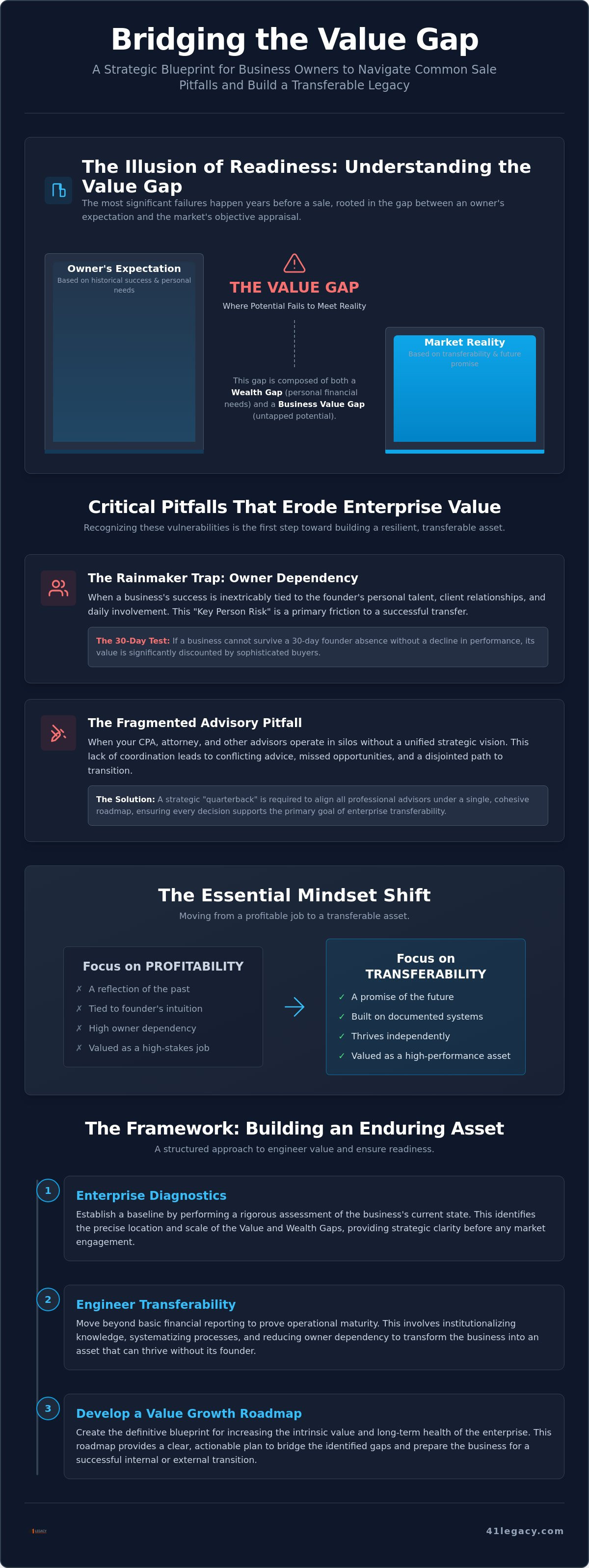
The 41 Legacy Framework: Building a Transferable Asset That Endures
The transition of a business is the final expression of a founder's stewardship. It's a moment that requires more than just a willing buyer; it demands an enterprise that has been meticulously prepared to stand on its own. Many owners are caught unprepared by the sudden reality of a market appraisal, falling victim to common business sale pitfalls that could have been engineered out years in advance. Our framework is designed to move you from the uncertainty of a founder led job to the strategic clarity of a transferable asset. This process is not a transactional event but a high performance refinement of the business's inner essence.
Our Enterprise Diagnostics phase serves as the initial unveiling, a rigorous examination that uncovers the raw truth of your company's current standing. We look beyond the surface level financials to identify the "Value Gap" that exists between your desired exit price and the market's objective reality. By establishing this baseline, we can develop a tailored Value Growth Roadmap. This document acts as the architectural blueprint for your legacy, detailing the exact steps required to reduce owner dependency and strengthen the structural integrity of your organization.
Strategy without execution is merely a hope. To ensure the roadmap is followed with surgical precision, we provide Monthly Implementation Support. We act as the strategic quarterback for your professional team, coordinating the efforts of your advisors to ensure every action moves you closer to a state of total readiness. This recurring advisory support is what bridges the gap between high level vision and granular operational excellence, ensuring that momentum is never lost to the distractions of daily management.
The Path from Diagnosis to Implementation
Project based diagnostics identify value leaks immediately, allowing us to prioritize the most impactful improvements. While many in the industry focus on the finality of a transaction, our focus remains on exit readiness. We don't provide brokerage services because our mission is to build an asset that is so structurally sound it commands interest naturally. By institutionalizing your unique intuition into repeatable systems, we ensure the business retains its value long after you've handed over the keys. It's about creating a living entity that carries your vision forward without requiring your constant intervention.
Securing Your Legacy
Building a business that thrives independently of its creator is the ultimate act of leadership. It requires a philosophical shift from being the indispensable "Rainmaker" to becoming the curatorial steward of a high performance system. This transition can begin today, regardless of whether your intended exit is two years or ten years away. The sooner you begin de-risking the enterprise, the more options you'll have when the time comes to step away. To take the first step toward strategic clarity, we invite you to Begin your Enterprise Diagnostics with 41 Legacy today.
- Truth: Uncover hidden risks through a structured diagnostic process.
- Clarity: Follow a tailored roadmap designed to bridge your specific Value Gap.
- Support: Benefit from a strategic quarterback who keeps your advisory team aligned.
- Impact: Build a legacy that endures through engineering and transferability.
Refining Your Enterprise for an Enduring Legacy
Engineering a transferable asset is a sophisticated endeavor that requires both technical precision and a profound respect for the history of the enterprise. By shifting focus from a transactional event to long-term operational maturity, you ensure the essence of your life's work is preserved for the next generation of leadership. This transition demands more than just clean financial statements; it requires a coordinated advisory team and a commitment to reducing owner dependency. Successfully navigating common business sale pitfalls is only possible when you possess a clear, diagnostic understanding of your current value and a roadmap to bridge the gap.
We provide the CEPA-led leadership and structured methodology necessary to act as your strategic quarterback, aligning every professional voice toward a singular goal. Our Enterprise Diagnostics process identifies hidden risks and establishes the architectural foundation for your transition. This approach transforms your business from a personal job into a high-performance asset that thrives independently of its creator.
Secure your legacy and bridge your value gap with a 41 Legacy Exit Readiness Assessment.
The path toward a successful transition is a journey of refinement and stewardship. We look forward to helping you build a future that honors your past while securing your enduring impact.
Frequently Asked Questions
What is the most common reason a business sale falls through?
The primary reason transitions fail is a lack of operational readiness. When a buyer discovers that the business's success is tied to the founder's intuition rather than documented systems, the perceived risk becomes untenable. This misalignment between an owner's expectations and the market's reality often causes deals to collapse during due diligence. It's a quiet tragedy that can be avoided through early diagnostic work.
How far in advance should I start planning my business exit?
Strategic planning should ideally begin three to five years before your intended departure. This timeframe allows for the deliberate engineering of transferability and the reduction of owner dependency. Starting early ensures you have the necessary runway to bridge value gaps and refine the enterprise into a turnkey asset. It's about building a business that is always ready for a transition, regardless of the timeline.
What is owner dependency, and why does it affect my business value?
Owner dependency occurs when the enterprise relies on the founder for sales, relationships, or critical decision making. Buyers view this as a significant "Key Person Risk" because the business's essence might vanish when the owner leaves. Reducing this dependency is essential to protecting the long term health and value of your legacy. A business that can't survive a month without its leader isn't an asset; it's a job.
Can I sell my business if I don’t have documented SOPs?
You can attempt a sale without documented procedures, but you'll likely face a substantial valuation discount. SOPs are the evidence of operational maturity that sophisticated buyers require to feel confident in future performance. They transform the business from a personal practice into a transferable asset that can thrive under new stewardship. Documentation is the differentiator that proves your success is repeatable and sustainable.
How is an Exit Readiness Assessment different from a traditional business valuation?
A traditional valuation provides a historical price tag, while an Exit Readiness Assessment evaluates the structural integrity of the enterprise. We look beyond the balance sheet to identify the risks and opportunities that affect transferability. This diagnostic approach ensures you're prepared for the rigors of the market, helping you avoid common business sale pitfalls that valuations alone cannot address. It's the difference between knowing your price and knowing your worth.
What role does a "Quarterback" play in the business sale process?
The Quarterback coordinates your professional advisors, such as your CPA and attorney, into a single, unified strategy. This role eliminates the silos that often lead to conflicting advice and deal fatigue. By maintaining a "professional-room altitude," the Quarterback ensures that every technical detail supports your ultimate legacy goals. This coordination is vital for maintaining momentum and ensuring a seamless transition of the enterprise.
What is the "Value Gap," and how do I calculate it?
The "Value Gap" is the difference between the net proceeds you need for your next chapter and what the market currently offers. Calculating it requires a deep dive into your personal financial needs and an objective Enterprise Diagnostics process. Identifying this gap early allows you to implement a Value Growth Roadmap to bridge the distance. It provides the strategic clarity needed to focus on the drivers that actually increase enterprise value.
Do I need a broker if I am already working with an exit planning advisor?
These roles are distinct and complementary. An exit planning advisor acts as a guardian of your readiness, engineering the business to ensure it is a high performance asset. A broker or investment banker then takes that refined asset to the market. Working with an advisor first helps you avoid common business sale pitfalls that often derail transactions before they reach the finish line. It ensures you're selling from a position of strength and clarity.
Disclaimer
This article is for educational and informational purposes only and does not provide legal, tax, investment, or business brokerage advice. 41 Legacy does not offer M&A brokerage services, legal document drafting, tax preparation, or investment advisory services. Business owners should consult licensed professionals in those disciplines before making decisions related to business transactions, legal matters, tax strategy, or financial planning. All examples are illustrative and may not apply to your specific situation.