
Transferability & Owner Dependency
The Calculus of Legacy: How to Calculate Owner's Discretionary Earnings (ODE)
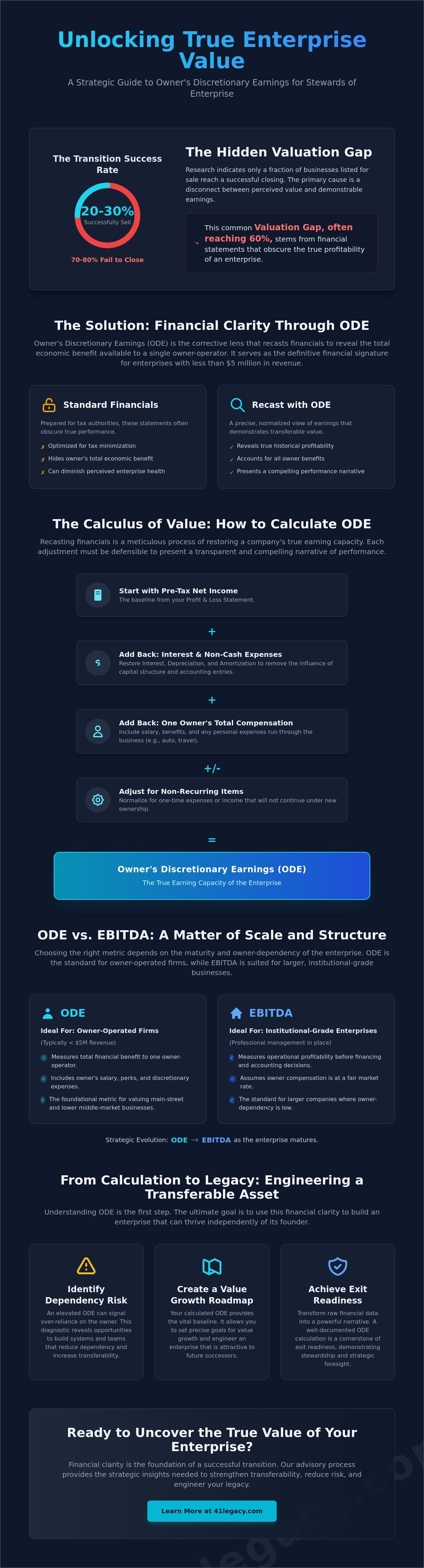
Research indicates that only 20% to 30% of businesses listed for sale actually reach a successful closing. This frequent failure stems from a valuation gap often reaching 60%, a discrepancy that arises when the true profitability of a legacy remains obscured by standard tax reporting. You understand that your financial statements, while technically accurate, rarely reflect the full vitality of the enterprise you've cultivated. Learning how to calculate owner's discretionary earnings is the essential discipline required to bridge this gap and illuminate the true historical benefit of your life's work.
You've likely felt the quiet anxiety that your business is too dependent on your personal presence, or perhaps you're confused by which discretionary expenses can be rightfully added back to your bottom line. We'll guide you through the sophisticated art of recasting your financials to reveal a precise, normalized view of your earnings. This framework provides the strategic clarity needed to increase enterprise value and build a transferable asset that thrives independently of its founder. We'll examine the specific categories of add-backs and the normalization adjustments that define your company's ultimate worth.
Financial clarity is the foundation of stewardship. You will understand why Owner's Discretionary Earnings serves as the definitive financial signature for enterprises with less than $5 million in earnings.
Precision requires a meticulous eye. This guide details the professional process of recasting your income statement to master how to calculate owner's discretionary earnings with surgical accuracy.
Reveal the essence of your profitability. Learn to distinguish between personal benefits and essential enterprise expenses to identify legitimate add-backs that reflect your company's true value.
Value is found in independence. Recognize how an elevated ODE may signal operational risks if the financial health of the asset is inextricably tied to your daily presence.
Transform data into a legacy. Discover how to use these financial diagnostics as a vital baseline for your Value Growth Roadmap and the engineering of a transferable asset.
Beyond the Balance Sheet: Defining Owner's Discretionary Earnings
The financial statements prepared for tax authorities often act as a veil, obscuring the true vitality of an enterprise. While these documents fulfill regulatory obligations, they rarely reflect the actual economic power generated by a founder's dedication. Owner's Discretionary Earnings (ODE) serves as the corrective lens, revealing the total financial benefit available to a single owner-operator. For businesses with less than $5 million in annual revenue, this metric provides the essential foundation for understanding enterprise value. Mastering how to calculate owner's discretionary earnings is the first step in lifting this veil and is a critical component of a comprehensive Exit Readiness Assessment.
By normalizing earnings, we strip away the idiosyncratic expenses of the current leadership to show what a successor could realistically expect to harvest. It's a process of financial restoration. This ensures the asset is viewed not as a tax-minimization vehicle, but as a high-performance engine of wealth. This clarity allows a steward to present their life's work with the precision it deserves.
The Philosophy of True Earnings
Accounting profit is a construct of compliance; discretionary cash flow is a reality of performance. Tax-optimized statements intentionally minimize reported income to preserve capital, yet this same strategy can inadvertently diminish the perceived health of the enterprise during a transition. We view ODE as a measure of the company's economic engine. It captures every dollar of value the business produces for its owner, regardless of how it's categorized on a profit and loss statement. This distinction is vital for any steward who wishes to demonstrate the true legacy of their work.
ODE vs. EBITDA: Choosing the Right Lens
The choice between ODE and EBITDA is a matter of scale and structure. EBITDA remains the standard for larger, institutional-grade enterprises where management is professionalized and owner-dependency is low. However, for owner-operated firms, ODE is the more appropriate metric because it accounts for the significant personal add-backs and owner compensation that EBITDA often ignores. As an enterprise grows and the founder's daily involvement decreases, your strategic roadmap should eventually transition from tracking ODE to EBITDA. This shift signals that the business has evolved into a mature, independent asset capable of thriving beyond its original architect.
The Calculus of Value: How to Calculate ODE with Precision
Recasting a financial statement is more than a simple audit. It's a meticulous restoration of a company's true earning capacity. To determine the enterprise value of your life's work, you must look beyond the bottom line of a tax return. Precision in this phase is paramount. Every adjustment you make must be defensible to a sophisticated observer, as these figures identify the 'Value Gap' between your current financial reality and your ultimate legacy goals. Mastering how to calculate owner's discretionary earnings allows you to present a narrative of performance that is both transparent and compelling.
The Fundamental ODE Formula
The process begins with a standardized baseline. This numerical foundation ensures that your valuation rests on a bedrock of institutional-grade logic. This process aligns with the standard Seller's Discretionary Earnings Definition, which serves as a guide for identifying the total cash flow available to a single owner-operator. The formula follows a logical progression:
- Step 1: Begin with the Net Income found on your most recent fiscal year's tax return or profit and loss statement.
- Step 2: Add back Interest Expense and Taxes. This creates a pre-finance, pre-tax baseline that removes the influence of your specific capital structure.
- Step 3: Add back Non-Cash Expenses. You'll restore Depreciation and Amortization to the total, as these accounting entries don't represent actual cash outflows.
Normalizing the Financial Narrative
True precision requires adjusting for anomalies that won't recur under new stewardship. If you've made significant one-time capital expenditures for equipment that won't need replacement for a decade, those costs should be added back. Similarly, market-rate adjustments are essential. If you own the building and pay yourself rent that's significantly above or below the local market average, the earnings must be normalized to reflect what a successor would realistically pay. These adjustments ensure the financial story you tell is one of sustainable excellence.
These nuances are why many stewards engage a 'quarterback' advisor to oversee the process. Ensuring your financial recasting is accurate requires a deep understanding of both the art and the engineering of value. Through our Enterprise Diagnostics, we help you uncover these hidden strengths and prepare your financials for a seamless transition. By refining these numbers today, you ensure that your legacy is measured by its true potential rather than its tax-optimized past.
Identifying Add-Backs: Distinguishing Personal Benefit from Enterprise Expense
The true measure of an enterprise's vitality often lies hidden within the nuances of its expenditure. Recasting your financials is a process of separation; it requires you to distinguish between the costs of running the business and the costs of supporting your specific lifestyle. When learning how to calculate owner's discretionary earnings, you must recognize that a successor won't necessarily share your compensation requirements or your personal preferences. This realization is the cornerstone of building a transferable asset. Every adjustment you identify must be supported by clear, indisputable documentation to maintain credibility in the eyes of a sophisticated advisor. Credibility is the currency of transition, and without it, the perceived value of your life's work remains vulnerable to skepticism.
Standard and Discretionary Adjustments
The most common add-backs are those that directly benefit the primary founder. This begins with your W-2 salary and any bonuses paid throughout the fiscal year. It also includes the full suite of benefits you enjoy as the steward of the company. For instance, in 2026, the maximum employee contribution to a 401(k) is $24,500, and any employer-paid portion of this or health and life insurance premiums are legitimate add-backs. Beyond these standard items, discretionary expenses reflect the unique way you choose to lead. These might include personal travel, club memberships, or company vehicles used for personal transit, where the 2026 standard mileage rate of 72.5 cents per mile can help quantify the adjustment. These figures are not just numbers; they represent the personal rewards of your leadership that a new owner would reclaim as profit.
Non-Recurring and Extraordinary Items
A precise calculation must also account for financial events that don't reflect the daily pulse of operations. These are often one-time legal fees or settlement costs that won't burden a future owner. We define extraordinary items as events unlikely to repeat within a five-year cycle. This category also includes exceptional repairs or "acts of God," such as property damage from a specific storm, that temporarily impacted your P&L. By categorizing these adjustments into standard, discretionary, and non-recurring buckets, you provide a transparent view of the company's economic engine. This level of detail is essential for anyone seeking how to calculate owner's discretionary earnings with the precision required for a successful transition. It ensures that the enterprise is valued for its inherent strength rather than its historical anomalies.
The Hidden Cost of Dependency: Why High ODE Can Signal Risk
While mastering the technical process of how to calculate owner's discretionary earnings provides a vital numerical baseline, the sheer magnitude of that figure can occasionally be deceptive. A robust ODE isn't always a signal of institutional strength; in some contexts, it serves as a warning of structural fragility. If a high earnings figure is the byproduct of a founder's eighty-hour work week, the business isn't yet a transferable asset. It's a high-paying job. Sophisticated observers look past the surface-level profitability to identify the Owner Dependency trap, where the very essence of the company's success is inextricably tied to its creator's daily presence.
The Transferability Trap
There's a subtle irony in the pursuit of high ODE. When a founder acts as the primary rainmaker, lead technician, and strategic architect, the discretionary earnings may appear impressive on paper, yet the valuation multiple often suffers. This Rainmaker Problem creates a ceiling on enterprise value because a successor cannot easily replicate a lifetime of personal relationships and intuitive decision-making. To achieve a premium valuation, you must shift the focus from maximizing personal cash flow to engineering a self-sustaining entity. True enterprise value is protected only when the business can thrive, and even grow, entirely independently of its architect.
Reducing Founder Friction
The path to a lasting legacy often requires the intentional sacrifice of short-term discretionary earnings. By investing a portion of that ODE back into the enterprise to hire a management layer or formalize systems, you begin the process of building a more resilient structure. This isn't a loss of profit; it's the purchase of transferability. Our Enterprise Diagnostics are designed to pinpoint exactly where you have become a bottleneck in your own creation. Identifying these points of friction allows you to transition from an active operator to a steward, building an asset that possesses its own momentum.
Every hour you reclaim from the daily operations is an hour added to the strategic health of the firm. As the business becomes less reliant on your individual effort, its risk profile decreases and its attractiveness to high-caliber successors increases. This shift ensures that the legacy you've built isn't just a collection of historical earnings, but a living, breathing asset capable of enduring for generations. If you are ready to identify the hidden risks in your current structure, our Strategic Capacity Evaluation offers the clarity needed to move forward with confidence.
Engineering a Legacy: Moving from Calculation to Exit Readiness
Understanding how to calculate owner's discretionary earnings is a critical milestone, but it remains a diagnostic entry point. The number itself is a static snapshot; it tells you where the business has been, not where it's capable of going. To transform a successful operation into a lasting legacy, you must move beyond the calculator. This is the stage where financial data matures into a strategic asset. You're no longer just measuring profit. You're engineering transferability and insulating the firm's future from current risks. It's the transition from being an operator to becoming a true steward of value.
A Value Growth Roadmap uses your ODE as the baseline to identify the 'Value Gap.' This gap represents the distance between the current market value of your enterprise and the financial requirements of your next chapter. Given that the average small business under $5 million in revenue sold for approximately 2.5 times its SDE in 2025, according to Business Valuation | We Are Calculator, even a modest increase in your multiple can result in a profound appreciation of your life's work. By setting monthly milestones to reduce owner dependency and improve operational clarity, you ensure the business evolves into a more attractive asset for a successor.
The Value Growth Roadmap
Maintaining momentum during this transformation requires disciplined execution. Implementation is where the true value is realized; it's the difference between a plan that sits on a shelf and a legacy that thrives in the hands of a new steward. This is why Strategic Advisory is essential. It provides the external perspective needed to stay focused on high-value activities while managing the complexities of a transition. We help you track the appreciation of your life's work through structured milestones, ensuring that every operational improvement translates directly into increased enterprise value.
Coordinating the Advisory Team
Effective exit readiness isn't a solo endeavor. It requires the precise orchestration of a coordinated team. We act as the 'quarterback,' aligning the technical expertise of your CPAs, attorneys, and wealth managers toward a singular vision. This collaboration ensures that your financial recasting remains consistent with your legal and tax structures, preventing the friction that often derails a transition. You've spent decades building this enterprise. It deserves to be treated as a transferable masterpiece, refined with the same care and precision you applied to its creation. Through our Monthly Implementation Support, we provide the steady guidance needed to navigate this final, most important phase of stewardship.
The Architect's Final Refinement
Your business is more than a sequence of transactions; it's a living testament to your vision and persistence. While understanding how to calculate owner's discretionary earnings provides the necessary financial baseline, the true value of your work is found in its ability to endure without you. We've explored how recasting your financials reveals the economic engine of the firm, yet we've also identified that high earnings mean little if they are tethered to founder-dependency. True stewardship requires moving beyond the diagnostic phase. It demands a structured approach to growth that prioritizes transferability and strategic clarity.
Led by a Certified Exit Planning Advisor (CEPA), our team utilizes a rigorous Enterprise Diagnostics process to help you bridge the gap between your current reality and your ultimate legacy goals. We focus on owner-dependency reduction to ensure your asset is viewed as a high-performance masterpiece ready for its next chapter. Every decision you make today either strengthens or weakens the foundation of your eventual transition.
Begin your journey toward a transferable legacy with an Exit Readiness Assessment. You've spent a lifetime building this essence; now is the time to ensure it remains protected and prepared for the future.
Frequently Asked Questions
Is ODE the same as Seller's Discretionary Earnings (SDE)?
Yes, these terms are functionally synonymous in the context of owner-operated business valuation. Both metrics represent the total cash flow available to a single owner after recasting the financials for discretionary and non-recurring items. While the term SDE is common in transactional circles, we prefer ODE because it emphasizes your ongoing stewardship and the strategic health of the enterprise as a living asset.
Can I add back the salaries of family members who work in the business?
You may add back family salaries only if their compensation exceeds the fair market rate or if their roles are not essential to future operations. If a family member receives $100,000 for a role that typically commands $60,000, the $40,000 difference is a legitimate normalization adjustment. Precise documentation is required to defend these adjustments to sophisticated observers who value transparency in your financial narrative.
How do I calculate ODE if I have multiple owners?
The standard calculation adds back the compensation and benefits of only one full-time owner-manager. For additional owners, their compensation must be adjusted to market rates rather than being added back in full. This ensures the earnings reflect what a successor would realistically harvest while maintaining a professional management structure. It's a critical step in understanding how to calculate owner's discretionary earnings for partnership-led firms.
What happens if my ODE is high but my business is not growing?
A stagnant business with high ODE often suggests that the owner is harvesting maximum cash flow at the expense of future investment. While the current yield is attractive, a lack of growth can lead to a lower valuation multiple because the risk of obsolescence is higher. Sophisticated successors prefer a balance where a portion of discretionary earnings is reinvested into systems that enhance transferability and long-term vitality.
Should I include interest on my business loans in the ODE calculation?
Yes, interest expense is a standard add-back because it relates to your specific capital structure rather than the company's operating performance. By adding back interest, you create a pre-finance baseline that allows a successor to evaluate the asset based on their own funding capacity. This normalization is essential for lenders, who typically look for a debt service coverage ratio of 1.15x to 1.25x when underwriting acquisition loans.
How many years of financial data should I use to calculate a reliable ODE?
A reliable calculation generally requires three years of historical financial data to establish a clear trend of performance. Using a multi-year weighted average accounts for year-over-year fluctuations and demonstrates the consistency of the company's economic engine. This historical perspective is vital for defending your valuation and proving that your discretionary earnings are a sustainable outcome of meticulous craftsmanship rather than a one-time anomaly.
Does a high ODE automatically mean my business is worth more?
Not necessarily, as the value of an enterprise is the product of its earnings and its risk-adjusted multiple. A high ODE that relies entirely on your personal presence creates an owner-dependency trap that significantly lowers the multiple. To increase worth, you must prove that the earnings are transferable and that the asset can thrive independently of your daily involvement. Value is found in the intersection of high earnings and low risk.
What is the difference between an add-back and a standard business expense?
An add-back is an expense that provides personal benefit or is non-essential for future operations, whereas a standard expense is vital to the company's daily pulse. Standard expenses, such as rent or utility costs, are necessary for any owner to generate revenue. Add-backs, like the 72.5 cents per mile you might claim for a personal vehicle in 2026, are discretionary choices that a successor would reclaim as profit.
Disclaimer
This article is for educational and informational purposes only and does not provide legal, tax, investment, or business brokerage advice. 41 Legacy does not offer M&A brokerage services, legal document drafting, tax preparation, or investment advisory services. Business owners should consult licensed professionals in those disciplines before making decisions related to business transactions, legal matters, tax strategy, or financial planning. All examples are illustrative and may not apply to your specific situation.