
Transferability & Owner Dependency
Standardizing Operations to Sell a Business: Build Transferability Before a Sale
What if a clear sign that a business is ready to transition is that it no longer needs its owner to explain how every important decision gets made? Many owners have strong businesses, but key processes still live in their heads, and results vary depending on who handles the work. Standardizing operations to sell a business means making essential work repeatable and visible, not documenting every detail.
The challenge is deciding which routines and decisions deserve attention first, and how to reduce owner dependency without creating unnecessary bureaucracy. This article explains how to identify work that relies heavily on you, establish practical standards, and connect operating consistency to transferability and enterprise value.
41 Legacy helps business owners understand the financial implications of decisions through a dual-lens evaluation of profit, cash, and enterprise value. The scope of each engagement is defined in the client’s written agreement. This article provides general information, not advice for a specific situation.
Key Takeaways
- Standardizing operations to sell a business starts with making critical work repeatable, clearly assigned, and easier to assess.
- Prioritize processes where owner-only decisions or inconsistent execution could interrupt continuity.
- Assess key routines for clear ownership, useful measures, current guidance, and a way to handle exceptions.
- Build consistency in stages: identify risk, prioritize high-impact work, assign responsibility, establish measures, and review results.
- Financial clarity can help owners evaluate how operating decisions affect cash, profit, and enterprise value.
Why standardizing operations matters before you sell a business
“80 to 90 % of an owner’s net worth sits inside the business.” That makes the operating model more than an internal management concern. It affects how well the company can continue when the owner steps back. Standardizing operations to sell a business means making important work repeatable, assigning clear responsibility, and making performance visible. It does not mean documenting every task or promising a sale. It means reducing avoidable uncertainty about how the business functions beyond its founder.
Consider two employees handling the same customer request in different ways, or routine approvals waiting until the owner is available. The work may get done, but performance depends on who is involved and when the owner can respond. That makes continuity harder to assess. A prospective successor needs to understand not only what the business produces, but also how essential work gets done and who is accountable.
What does standardizing operations mean in a sale context?
Operational standards should focus on work that materially affects delivery, customers, risk, and results. A useful procedure explains the expected outcome, who owns the work, and what to do when a situation falls outside the usual pattern. It is a working reference, not a record of every keystroke. For broader context on standards, see the International Organization for Standardization (ISO).
Clear roles matter as much as written instructions. If a named team member can handle a customer issue within defined limits, work can continue when the owner is unavailable. Transferability is the business’s ability to operate beyond its current owner. It grows when knowledge, authority, and accountability are distributed well enough for others to deliver consistent outcomes.
Why does owner dependency create uncertainty?
Owner dependency often hides in ordinary decisions: approving discounts, remembering a key customer’s preferences, or deciding how to handle a late delivery. When these judgments rely on personal memory, employees may escalate routine matters or make inconsistent choices. The issue isn’t that the owner’s judgment lacks value. It’s that the business has limited ways to preserve and apply that judgment without the owner present.
Start by noting where work pauses for your approval, where customers rely on your personal relationships, and where exceptions are resolved from memory. Then define the decision boundary: what the responsible person can decide, what information they need, and when an issue should be escalated. The companion article, “What is an SOP in Business? The Blueprint for a Transferable Legacy,” explores how operating procedures can preserve essential knowledge and make it easier to use.
These steps can clarify continuity, but they can’t guarantee a sale or a particular outcome. Their practical value is helping the business function with less reliance on one person and making its operating model easier to understand during a future transition.
Build operating consistency beyond a stack of SOP documents
A procedure creates little value if employees can’t find it, follow it, or tell when it needs updating. Operating consistency depends on the habits around the document: someone owns the process, people understand the expected result, and changes in the work prompt a timely review. The aim isn’t a larger manual. It’s a dependable way to deliver important work.
An effective operating standard makes the expected result clear, assigns responsibility, and gives people a practical way to handle exceptions. This keeps attention on how work happens, not on how many pages have been written. For owners standardizing operations to sell a business, it also helps distinguish core practices from paperwork that adds little insight into continuity.
Which operating routines deserve clear standards?
Begin with recurring work that has a meaningful effect on customers, cash, quality, or the company’s ability to keep operating. Examine handoffs closely: a sales commitment passed to delivery, a completed job awaiting invoicing, or a customer issue moving between teams. Delays and rework at these points can signal unclear expectations or responsibility.
- Prioritize: Work that repeats and directly affects delivery or business performance.
- Examine: Handoffs where information is lost, work stalls, or corrections happen more than once.
- Defer: Low-impact administrative details that don’t materially affect results or continuity.
For example, a sales process standard might clarify what information must accompany a new customer commitment before delivery begins. Sandler’s discussion of standardized sales processes offers a related example of bringing consistency to a customer-facing routine. Set the level of detail according to the work: enough to make expectations clear, but not so much that people can’t use the standard.
How do roles, measures, and procedures work together?
Name an owner for each recurring process, even if several people perform the steps. Define who can make routine decisions, who handles exceptions, and what conditions require escalation. This gives employees room to act while providing a clear path for unusual situations.
Pair responsibilities with a small set of relevant key performance indicators (KPIs), or measures used to track results. Depending on the process, a team might review delivery timeliness, rework, or the time between completing work and invoicing. Measures are useful when they prompt focused questions: what changed, what caused it, and who is responsible for the next action? They do not guarantee a valuation result.
Consistent operating measures can make performance easier to understand, a theme explored in How to Increase Enterprise Value: A Comprehensive Guide for Business Owners. Owners seeking clearer financial context for operating decisions can explore 41 Legacy’s financial and enterprise-value advisory.
Assess operational standardization through a buyer’s lens
Reviewing operations from an outside perspective can reveal where continuity is clear and where work still depends on the owner. This is a diagnostic exercise, not a universal buyer checklist. Priorities differ by company, industry, and transition context. The goal of standardizing operations to sell a business is to understand and explain how important work is performed, who is accountable, and how the company responds when results depart from expectations.
What signs reveal owner dependency in daily operations?
Look for routine approvals that wait for the owner, customer relationships held mainly through personal contact, and operating knowledge that exists only in memory. Repeated workarounds, undocumented handoffs, and informal messages can also signal that processes depend on individual habits rather than shared practices. Leadership itself isn’t a problem. The key distinction is whether the owner sets direction or must personally unblock ordinary work.
| Owner-dependent practice | Repeatable, assigned, and reviewed practice |
|---|---|
| Routine decisions pause for the owner’s approval. | Decision limits are clear, with exceptions assigned to an appropriate decision-maker. |
| Customer preferences and history reside mainly with the owner. | Relevant customer information is accessible to the people responsible for service. |
| Employees use personal workarounds to complete handoffs. | Handoff expectations and responsibilities are understood across the people involved. |
| Problems are addressed informally, with little record of what changed. | Deviations are reviewed, actions are assigned, and follow-up is visible. |
What evidence helps explain whether operations are repeatable?
Consider process ownership, review cadence, and performance measures together. A procedure may describe the intended steps, while a named owner and periodic review show how the process is maintained. Relevant records can show whether the team notices a deviation, determines its cause, and follows through on corrective action. Use information the company actually tracks, and don’t present assumed buyer expectations as fact.
Financial information can help interpret operating patterns, but it may not reflect current conditions. “Three weeks late is how old the average owner’s financial picture is when the decision has to be made.” Compare available financial results with current operating records, such as work completed, delays, or unresolved exceptions. This can help identify where timing or visibility affects decisions. The purpose is to understand the evidence and its limits, not to claim that a particular measure proves transferability.
Use the comparison to ask focused questions: Which important activities can continue without the owner? Who can explain how performance is reviewed? What happens when an exception occurs? The answers help distinguish a real operating capability from a process that appears consistent only because the owner is quietly holding it together.
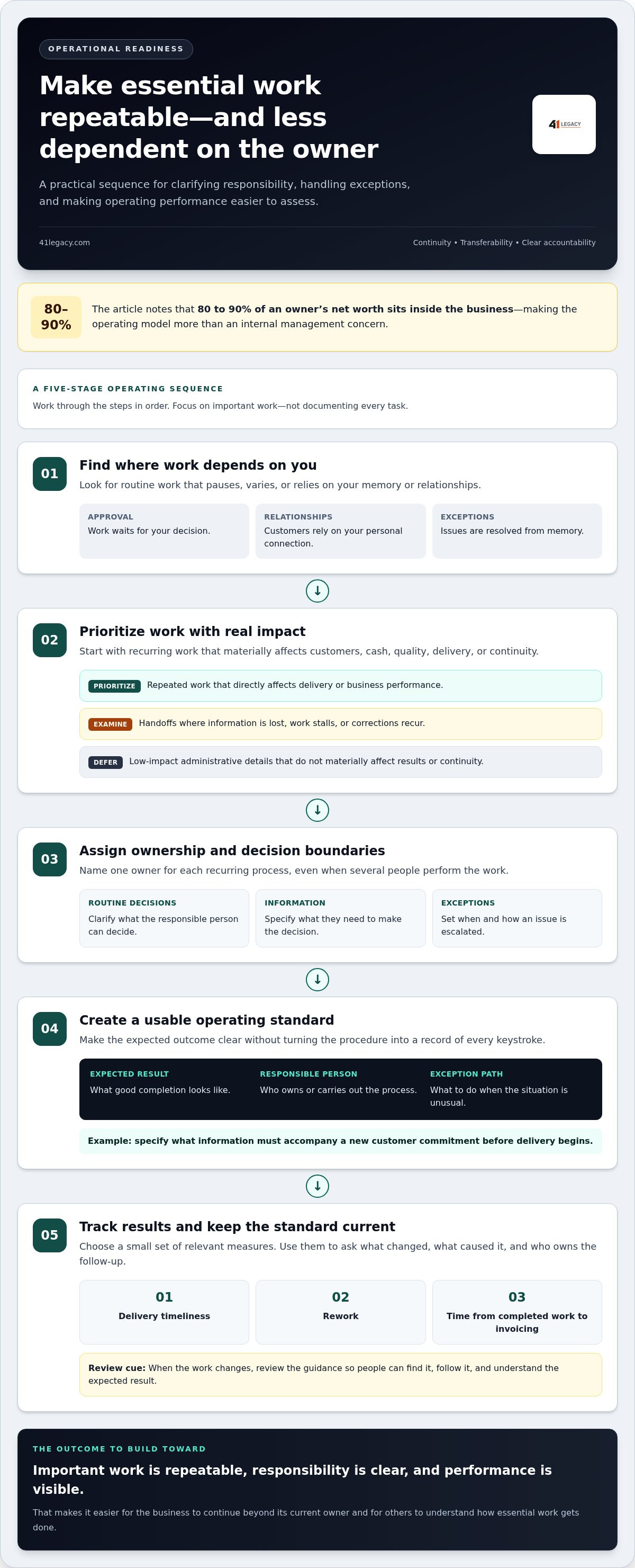
Standardize operations in a practical sequence before a transition
Operational changes are more likely to last when they become working practices, not simply new instructions. A company doesn’t need to redesign every department at once. For standardizing operations to sell a business, a disciplined rollout helps employees understand what is changing, test whether the guidance works in real conditions, and adjust it before applying it more broadly.
How should an owner choose what to standardize first?
Choose a contained piece of work that happens often enough to test and has a clear beginning and end. For example, focus on one handoff rather than rewriting an entire customer-delivery function. This keeps the effort manageable and makes it easier to tell whether unclear guidance or another part of the workflow is causing a problem.
- Set a clear boundary. Define where the selected workflow starts and ends, and which cases fall outside its scope.
- Observe the work in practice. Follow a representative example from beginning to end. Note where people pause, use another tool, or rely on an informal workaround.
- Create guidance at the point of use. Put the essential steps and references where employees perform the work, rather than creating a document that is difficult to find.
- Test the guidance with actual users. Have the people who perform the work use it for ordinary cases and note where instructions are unclear or missing.
- Refine before expanding. Incorporate useful feedback, remove outdated directions, and then consider applying the approach to related work.
How can a company sustain standards without adding bureaucracy?
Keep the guidance proportionate to the task. A short checklist, decision prompt, or clear handoff note may serve employees better than a lengthy procedure. Avoid keeping duplicate versions in different locations. Confusion about which copy is current can undermine consistency. When the work changes, update the version people actually use and explain the change in practical terms.
Gather employee feedback through channels the team already uses, such as onboarding conversations or routine discussions about completed work. The point is not to create another reporting layer. It’s to notice whether the guidance remains usable as conditions change and adapt it before informal workarounds become the real process.
This measured rollout can be part of wider transition preparation. Exit Planning for Business Owners: The Master Craftsman’s Guide to Transferable Legacy considers the broader readiness journey, while a focused operational pilot gives the company a practical place to begin. Owners assessing how financial decisions relate to transferability can explore 41 Legacy’s strategic advisory support.
Connect operational readiness to 41 Legacy’s financial clarity process
Operational improvements affect more than workflow. Changes to staffing, capacity, or delivery can influence cash needs and profit, while shaping how reliably the business performs. 41 Legacy provides fractional CFO, financial advisory, and enterprise-value services to help owners evaluate these financial implications alongside transferability priorities.
How does financial clarity support operational decisions?
Every recommendation uses a dual-lens evaluation: the decision’s profit and cash impact, and its enterprise-value impact. This gives owners a broader frame for considering a proposed operating change instead of focusing only on its immediate effect on expenses or revenue.
The fixed, six-week financial clarity intensive includes one working session per week and weekly deliverables. Weeks 1 and 6 are identical for every client; weeks 2-5 are customized after week 1. The week 3 deliverable is a 13-week cash-flow forecast. Together, these elements provide a structured way to examine the company’s financial picture and the questions that emerge during the process.
For ongoing strategic financial support, the CFO Seat provides budgeting, forecasting, KPI review, decision support, working-capital discipline, and enterprise-value tracking. These activities help owners connect operating choices with financial performance over time.
What is the first step for owners exploring readiness?
A first 30-minute conversation gives owners a place to discuss the decisions they’re weighing and where greater financial clarity could help. “No pitch. No pressure.” It is an opportunity to discuss needs and priorities, not a promise of a sale or a particular result.
For owners considering how operating choices relate to transition readiness, explore financial clarity and enterprise-value advisory.
Build a business that can carry its own momentum
A future transition is shaped by operating habits built long before a decision is made. The next step needn’t be a sweeping redesign. Choose one important point of dependence, clarify what should happen, and give someone the authority and responsibility to carry it forward. Then observe whether the work continues as intended and adjust where practice reveals a gap.
That steady discipline is the deeper purpose of standardizing operations to sell a business: strengthening an enterprise that can perform beyond the founder’s daily presence. The work can also give you a clearer basis for evaluating which improvements matter, how they affect the company, and where further readiness work may be warranted. Progress comes from sound decisions sustained over time, not documentation alone.
If you’re ready to examine the financial implications of operating decisions and strengthen enterprise-value clarity, start with a 30-minute conversation. No pitch. No pressure. Each deliberate improvement helps create a more resilient business and a stronger foundation for what comes next.
Frequently Asked Questions
Do buyers require every business process to be documented?
No. There isn’t a universal documentation rule, and the right format depends on how the information will be used. A quick-reference guide may help someone perform a task, while a training resource may explain the reasoning behind it. Before creating a document, identify its intended user and purpose. That simple test helps keep documentation useful instead of expanding it into a manual that employees rarely consult.
Can standardizing operations remove the owner from the business completely?
No. Standardization doesn’t mean the owner must leave or stop leading. A practical way to test continuity is to arrange for a capable team member to cover an ordinary operating period while the owner is unavailable. Notice which decisions still wait, where work is interrupted, and what information the substitute needs. Use those observations to plan a gradual transfer of responsibilities without diminishing the owner’s strategic contribution.
How long before a sale should a business standardize its operations?
There’s no fixed lead time that fits every company. The time needed depends on how complex the work is and how often employees perform it. If demand changes by season, for example, a process tested only during a quiet period may not reflect peak conditions. Consider whether the team has observed the standard under the operating conditions that matter before relying on it as evidence of readiness.
Will standardizing operations guarantee a higher sale price?
No. Clearer procedures alone can’t establish a sale price or guarantee a financial outcome. To understand whether an operating change is helping, compare its intended purpose with what actually changed in the business, such as service disruptions or delivery predictability. Keep the record factual and avoid treating a single improvement as proof of a specific future result. Operational readiness is one consideration among many.
Should a small company standardize operations if the owner is not selling soon?
Yes. Even without an immediate transition plan, clear work instructions can make it easier to onboard a new employee or cover a role during an absence. For example, a team member stepping into a recurring responsibility can use a clear reference rather than relying on repeated verbal explanations. Starting with a process that would be difficult to cover can strengthen continuity and give the owner more room to focus on other priorities.
How can employees help keep operating procedures useful?
Employees can test whether a procedure is understandable without relying on the person who wrote it. Invite someone less familiar with the task to use the guidance and identify where they need clarification. Their questions can expose assumptions experienced staff no longer notice. This usability check helps make instructions more accessible to the wider team and can reduce dependence on informal explanations during training.
Does 41 Legacy provide legal, accounting, or investment advice as part of its financial clarity process?
No. 41 Legacy provides fractional CFO, financial advisory, and enterprise-value services only. It is not a CPA firm and does not provide audit, review, or other attest services, legal advice, or investment advice. Site information is general in nature, not advice for a specific situation, and the scope of each engagement is defined in the client’s written agreement.
Disclaimer
This article is for educational and informational purposes only and does not provide legal, tax, investment, or business brokerage advice. 41 Legacy does not offer M&A brokerage services, legal document drafting, tax preparation, or investment advisory services. Business owners should consult licensed professionals in those disciplines before making decisions related to business transactions, legal matters, tax strategy, or financial planning. All examples are illustrative and may not apply to your specific situation.