
Transferability & Owner Dependency
How to De-Risk a Business for a Potential Buyer: Building a Transferable Legacy
What if the decades you spent perfecting your craft have inadvertently become the greatest threat to your company’s future value? You've likely felt the weight of knowing that while your business thrives under your hands, it might falter without them. It's a common anxiety shared by many of the 13,000 sponsor-backed businesses currently held in private hands; the fear that a lifetime of work could lose its luster during the scrutiny of due diligence. You deserve to understand exactly how to de-risk a business for a potential buyer by moving beyond the role of the daily operator and into the position of the steward who builds for the long term.
This article provides a sophisticated strategic framework for transforming your business into a de-risked asset that thrives independently of its founder. We will examine the mechanics of transferability engineering and how enterprise diagnostics can replace uncertainty with a higher valuation multiple at exit. By following this roadmap, you'll gain the clarity needed to reduce owner dependency and the peace of mind that your legacy will endure through a successful transition. We'll move from the conceptual to the practical, ensuring your enterprise remains vital and high-value long after you step away.
Key Takeaways
- Discover the direct correlation between risk mitigation and valuation multiples to master how to de-risk a business for a potential buyer through strategic clarity.
- Identify and escape the "Rainmaker Trap" by engineering a company that operates with precision independent of the founder’s daily involvement.
- Transform operational processes into meticulous blueprints that preserve the integrity of your enterprise while ensuring its future transferability.
- Use enterprise diagnostics to bridge the value gap between your current standing and the enduring legacy you intend to build.
- Learn to coordinate your professional advisors into a unified front, ensuring a seamless transition that honors your lifetime of uncompromising work.
The Architecture of Transferability: Why Buyers Pay for Mitigated Risk
De-risking is the systematic identification and removal of obstacles that prevent a seamless transition of ownership. It is not merely a defensive posture; it is a proactive refinement of the enterprise. In the same way a master technician strips a vintage engine to its core to ensure every component meets a standard of excellence, a business owner must evaluate the internal mechanics of their company. Understanding how to de-risk a business for a potential buyer requires a shift in perspective. You are no longer just an operator; you are a steward preparing a masterpiece for its next gallery.
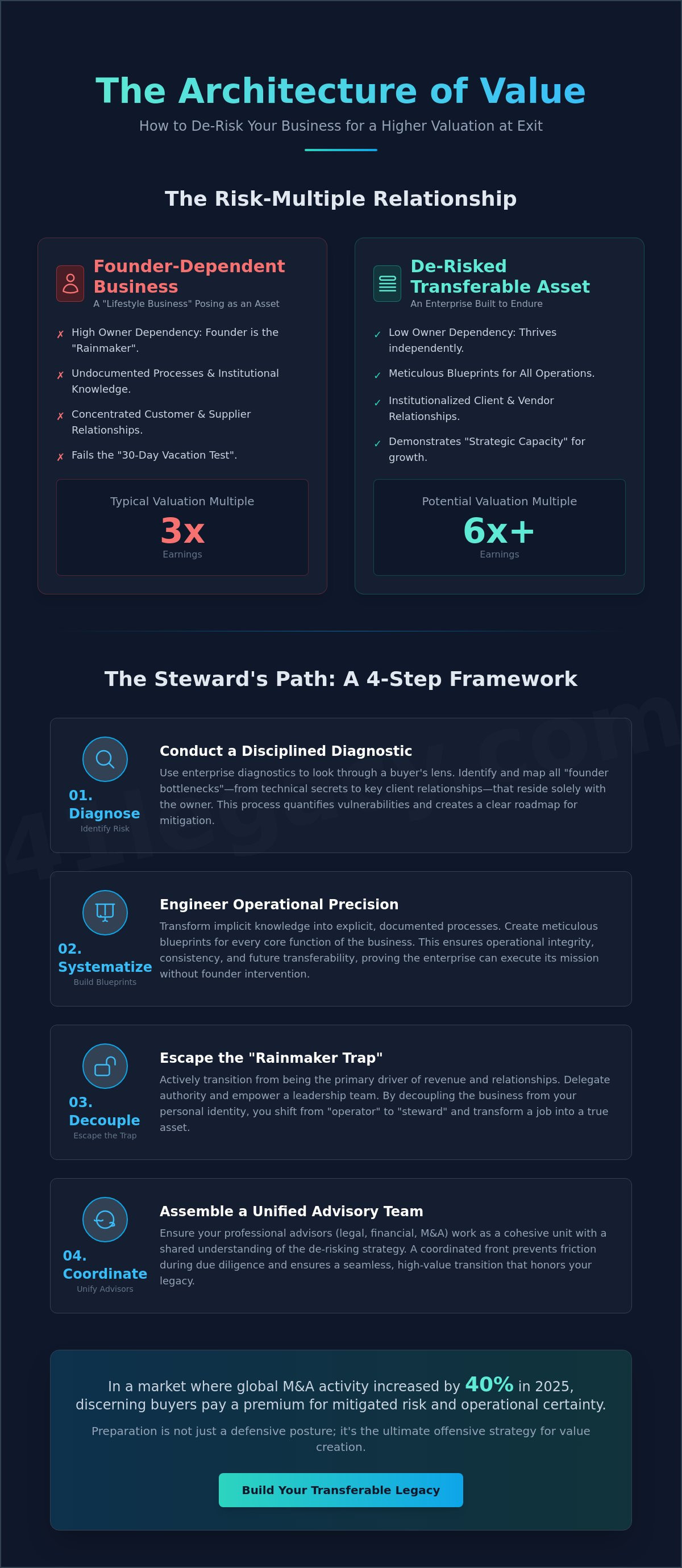
The relationship between risk and valuation is absolute. In the current market, where global M&A activity increased by 40% in 2025, buyers are increasingly discerning. They do not just buy cash flow; they buy the probability that those earnings will continue under new leadership. This is the "Risk-Multiple" relationship. A business with high owner dependency might trade at a 3x multiple, while a de-risked, systematized asset could command 6x or higher. By reducing uncertainty, you directly increase the enterprise value. You are moving from a "lifestyle business," which is often a sophisticated job for the founder, to a "transferable asset" that possesses its own independent soul.
Understanding the Buyer’s Lens
Private equity and strategic buyers view your business through a lens of institutional skepticism. During due diligence, they look beyond the balance sheet to find "concealed strategic risk." This includes everything from customer concentration to undocumented processes. Professional investors often utilize Enterprise Risk Management Frameworks to quantify these vulnerabilities. A "clean" business, free of these operational frictions, attracts more competitive bidding environments. When multiple buyers see a low-risk opportunity, the tension of the market naturally drives the valuation upward, rewarding the owner for their meticulous preparation.
The Concept of the Transferable Asset
A business achieves true transferability when it demonstrates "Strategic Capacity," the ability to grow without the founder’s constant input. This requires a transition from individual brilliance to collective excellence. A transferable asset is a company that possesses the systems and talent to execute its mission without founder intervention. At 41 Legacy, we view this as the pinnacle of craftsmanship. It ensures that the company can thrive from day one of new ownership, preserving the heritage you built while offering the buyer a clear path toward future evolution. This level of readiness is the ultimate gift to your legacy.
Escaping the Rainmaker Trap: Reducing Owner Dependency
The Rainmaker Trap is a gilded cage. It exists when the founder remains the primary driver of revenue; the sole guardian of key relationships; and the only repository of technical mastery. While this concentration of influence may feel like control, it is a significant liability in the eyes of an institutional investor. High owner dependency is a critical red flag that frequently results in aggressive earn-out structures or the complete collapse of a deal. To understand how to de-risk a business for a potential buyer, one must first accept that the enterprise must become greater than the individual who created it.
This transition from founder to steward is a philosophical evolution. It requires the same meticulous attention to detail that a master restorer applies to a classic chassis. By decoupling the business from your personal identity, you aren't just preparing for an exit; you're improving your current quality of life. A business that doesn't demand your presence for every minor decision is a business that allows for true strategic foresight. It creates the space necessary to focus on high-level growth rather than daily fires.
Identifying Founder Bottlenecks
The most effective diagnostic for this issue is the "Vacation Test." If the enterprise cannot function with uncompromising quality for 30 days without your input, you haven't yet built a transferable asset. You must map the institutional knowledge that resides solely in your mind. This includes technical secrets and critical client relationships that haven't been institutionalized. When a buyer sees that the company’s soul is locked in the founder's persona, they see a risk that could vanish the moment the ink dries on the contract.
Empowering the Next Tier of Leadership
Building a self-sustaining management layer is the hallmark of a mature enterprise. This involves reducing owner dependency by delegating decision-making authority to a capable team. You must incentivize these key employees to remain through the transition, ensuring the buyer inherits a functional brain trust. This process of Owner Dependency Reduction is a core value-growth strategy. It transforms the business from a collection of tasks into a coordinated symphony of talent. When leadership is distributed, the enterprise gains the strategic capacity to thrive under any ownership, securing both the value of the asset and the endurance of your legacy.
Strategic Capacity and Operational Precision: Systematizing the Enterprise
Excellence is never an accident. It is the result of high intention and sincere effort. In the context of transferability, this excellence is codified through systems. Standard Operating Procedures (SOPs) serve as the architectural blueprints of your corporate legacy. They ensure that the uncompromising quality you've established remains consistent after the keys change hands. Buyers don't want to buy a mystery; they want to buy a machine with a clear operator's manual. When you document every process with meticulous care, you are defining how to de-risk a business for a potential buyer by providing a repeatable engine for success.
This level of operational precision mirrors the standards of high-end automotive engineering. Just as a bespoke restoration requires every bolt to be torqued to an exact specification, your enterprise requires documented workflows to maintain its integrity. Systems mitigate the risk of "key person" departures. If a vital team member leaves, the institutional knowledge remains within the company's "instruction manual." This allows the soul of the business to endure, regardless of who is behind the wheel. In a market where 55% of the 13,000 sponsor-backed businesses have been held for five years or more as of May 2026, buyers are specifically seeking this level of institutional stability.
The Role of Documented SOPs
Turning tribal knowledge into a scalable framework is the first step toward true enterprise value. SOPs provide buyers with the confidence that they can replicate your results from day one. This documentation acts as a bridge between your era of leadership and the next. For those seeking to refine these internal mechanics, exploring value growth advisory can provide the necessary strategic clarity. It transforms a collection of individual tasks into a coordinated, high-performance asset that thrives on its own merit.
Diversification as a De-risking Tool
Operational precision must also extend to the company's external dependencies. Customer concentration is a significant red flag in any due diligence process. Ideally, no single client should represent more than 15% of your total revenue. This protects the enterprise from the sudden loss of a major account. Beyond customers, you must consider:
- Supplier Diversification: Ensuring your supply chain isn't reliant on a single source or a single geographic region.
- Service Evolution: Developing multiple product lines to ensure long-term market relevance and revenue stability.
- Vendor Redundancy: Protecting the operational flow from external shocks by having pre-vetted alternatives.
By diversifying these elements, you strengthen the strategic capacity of the business. You aren't just selling a snapshot of current profits; you're offering a resilient, future-proof legacy that commands a premium in a competitive market.
A Disciplined Diagnostic: Identifying and Closing the Value Gap
Before you can engineer a successful transition, you must first identify the structural weaknesses that remain hidden beneath the surface of daily operations. Excellence requires a baseline. We call this first step Enterprise Diagnostics. It's the equivalent of a pre-purchase inspection for a rare vehicle, revealing the difference between what the owner believes the business is worth and what the market is actually willing to pay. This discrepancy is the "Value Gap." It represents the financial distance between your current valuation and the capital required to secure your future legacy and lifestyle.
In a market where the Wall Street Journal Prime Rate stands at 6.75% as of May 2026, the cost of capital is significant. Buyers are more risk-averse when SBA 7(a) loan rates reach as high as 13.25%. They'll aggressively discount any enterprise that hasn't undergone a rigorous de-risking process. Understanding how to de-risk a business for a potential buyer starts with a data-driven assessment of your exit readiness. You cannot fix what you haven't measured; you cannot grow what you haven't diagnosed.
The Diagnostic Process
Closing the value gap requires a disciplined, four-step approach to strategic preparation:
- Step 1: Conduct a comprehensive enterprise diagnostic to uncover hidden operational and structural risks.
- Step 2: Quantify the impact of each identified risk on your potential valuation multiple.
- Step 3: Develop a prioritized Value Growth Roadmap to address high-impact risks first.
- Step 4: Implement monthly accountability sessions to ensure the transition from operator to steward remains on track.
This structured methodology ensures that every hour spent on the business is an investment in its ultimate transferability. To begin your own evaluation, you can initiate an Exit Readiness Assessment to gain the strategic clarity necessary for a high-value exit.
Financial Transparency and Forecasting
Precision in your financial reporting is the hallmark of a de-risked asset. Many owners focus on tax-minimization accounting, which often obscures the true earning power of the enterprise. To maximize value, you must shift toward value-maximization reporting. This means maintaining "Due Diligence Ready" data at all times. Buyers look for robust financial forecasting that proves the business’s future viability without the founder's influence. When your numbers are meticulous and your forecasts are grounded in historical performance, you eliminate the uncertainty that leads to price concessions during negotiations. You're no longer just presenting books; you're presenting a verified history of excellence.
The Steward’s Path: Coordinating Your Advisory Team
The final stage of refining a transferable asset isn't found in the ledger or the workshop, but in the deliberate alignment of your professional counsel. Most owners possess a talented team of CPAs, attorneys, and RIAs, yet these experts often operate in silos. Without a central "Quarterback" to harmonize their efforts, strategic drift occurs. This fragmentation creates unnecessary friction and increases risk during a transition. Understanding how to de-risk a business for a potential buyer requires a unified front where every legal and financial decision serves the ultimate goal of enterprise readiness. It's about ensuring the engine of your business is tuned to perform for the next owner just as it has for you.
At 41 Legacy, we view this coordination as a form of high-level stewardship. We don't just look at the mechanics of a deal; we look at the preservation of a soul. By aligning your advisors, you protect the life’s work you've meticulously built. This isn't merely about a transaction; it's about the evolution of a legacy. When your advisory team moves in harmony, the business becomes a masterpiece of transferability, ready to endure and thrive long after your tenure as founder has concluded.
The Coordinated Advisory Advantage
A strategic advisor ensures that every individual piece of advice supports the long-term health of the company. It's easy to fall into the "transactional trap," focusing only on the immediate sale rather than the enduring strength of the asset. By coordinating your advisory team, you ensure that tax planning doesn't inadvertently damage transferability and that legal structures protect the company's core values. This expert-led strategy provides the peace of mind that comes from knowing your transition is being handled with surgical precision. It allows you to step back from the granular details, confident that the transition strategy is both unified and uncompromising in its quality.
Securing Your Legacy
The transition from "Owner" to "Architect" is the final evolution in building a lasting asset. This shift shouldn't be rushed. The best time to start the de-risking process is often three to five years before your intended departure. This lead time allows for the systematic removal of owner dependency and the full implementation of your value growth roadmap. You've spent a lifetime perfecting your craft and building an enterprise that reflects your standards. Now, you must ensure it has the structural integrity to survive the transfer of power. To begin this essential work, you should Schedule your Exit Readiness Assessment with 41 Legacy to begin your journey toward a secure and sophisticated legacy.
The Master Architect’s Final Act: Engineering Your Exit
Building a business is an act of creation; preparing it for transfer is an act of stewardship. You've moved from individual brilliance to collective excellence by codifying your systems and empowering a management team that functions with precision. By closing the value gap through disciplined diagnostics and aligning your advisors, you ensure that the enterprise’s soul remains intact long after you step away. This transformation from a founder-led company to a transferable asset is the ultimate expression of craftsmanship.
Mastering how to de-risk a business for a potential buyer is the final, most critical refinement in your professional journey. At 41 Legacy, our advisory is led by a Certified Exit Planning Advisor (CEPA) who provides the structured "Quarterback" approach needed to align your professional counsel toward a singular goal. We prioritize long-term transferability and enterprise value growth so your life's work remains a masterpiece of engineering. This disciplined preparation ensures that the transition of your legacy is as seamless as the machinery you've built.
Secure your legacy by starting your Exit Readiness Assessment with 41 Legacy today. Your commitment to uncompromising quality has brought you this far; let that same standard guide your successful transition into the future.
Frequently Asked Questions
What is owner dependency, and why does it devalue my business?
Owner dependency occurs when the founder is the primary engine of the company's daily operations and strategic decisions. It devalues the enterprise because a buyer sees a high risk of failure once the founder departs. If 100% of the institutional knowledge resides in one person, the business lacks transferability. Reducing this dependency is a core part of how to de-risk a business for a potential buyer, ensuring the asset thrives independently.
How long does it typically take to de-risk a business for sale?
A comprehensive de-risking process usually requires 36 to 60 months of disciplined preparation. This timeline allows for the systematic implementation of new leadership layers and the meticulous documentation of all operational procedures. Rushing this evolution often leads to price concessions during due diligence. Starting years in advance ensures the enterprise is ready for scrutiny and commands a higher valuation multiple at the point of transition.
Can I de-risk my business without hiring an M&A broker?
You can and should begin de-risking long before engaging transaction professionals. De-risking is a strategic operational endeavor focused on enterprise health rather than a transactional event. By utilizing enterprise diagnostics and value growth roadmaps, you can strengthen the business's internal architecture independently. This proactive stewardship makes the eventual transition smoother and more profitable, regardless of which professionals you later choose to assist with a transaction.
What are the most common risks that buyers look for during due diligence?
Buyers scrutinize customer concentration, undocumented processes, and the strength of the middle management team. They often use institutional frameworks to identify "concealed strategic risk" that could jeopardize future cash flow. In May 2026, with SBA 7(a) rates reaching 13.25%, lenders and buyers are particularly focused on financial transparency and the reliability of future forecasts. Any ambiguity in these areas is viewed as a significant liability.
How do Standard Operating Procedures (SOPs) impact my company's valuation?
SOPs act as the instruction manual for your corporate legacy, directly increasing the valuation multiple by reducing operational uncertainty. When processes are meticulously documented, the business becomes a repeatable engine of success rather than a collection of individual efforts. This transparency gives buyers the confidence that they can maintain uncompromising quality from day one, which justifies a premium price for the asset.
What is a 'Value Gap,' and how do I calculate mine?
The Value Gap is the difference between the current market value of your business and the net proceeds you need to fund your post-exit life. You calculate this by subtracting your current enterprise value from your total financial requirement for a successful legacy. Identifying this gap through an exit readiness assessment is the first step in prioritizing the strategic actions needed to increase the company's worth before a transition.
Is it possible to de-risk a business if I have a high customer concentration?
You can mitigate this risk by diversifying your revenue streams or formalizing long-term contracts with your primary clients. Ideally, no single customer should represent more than 15% of your total revenue to protect the enterprise from sudden shocks. If concentration exists, you must demonstrate a "Strategic Capacity" for growth in other market segments to prove the business’s long-term viability to a potential buyer.
Why isn't my CPA or Attorney already handling my exit readiness?
Most CPAs and attorneys focus on their specific disciplines, such as tax compliance or legal liability, rather than holistic enterprise value growth. While they are essential members of your advisory team, they often operate in silos without a unified strategic roadmap. A "Quarterback" approach is required to align these professionals toward the singular goal of transferability, ensuring that every legal and financial decision strengthens the business’s overall health.
Disclaimer
This article is for educational and informational purposes only and does not provide legal, tax, investment, or business brokerage advice. 41 Legacy does not offer M&A brokerage services, legal document drafting, tax preparation, or investment advisory services. Business owners should consult licensed professionals in those disciplines before making decisions related to business transactions, legal matters, tax strategy, or financial planning. All examples are illustrative and may not apply to your specific situation.