
Transferability & Owner Dependency
How to Create a Business Continuity Plan That Protects Enterprise Value
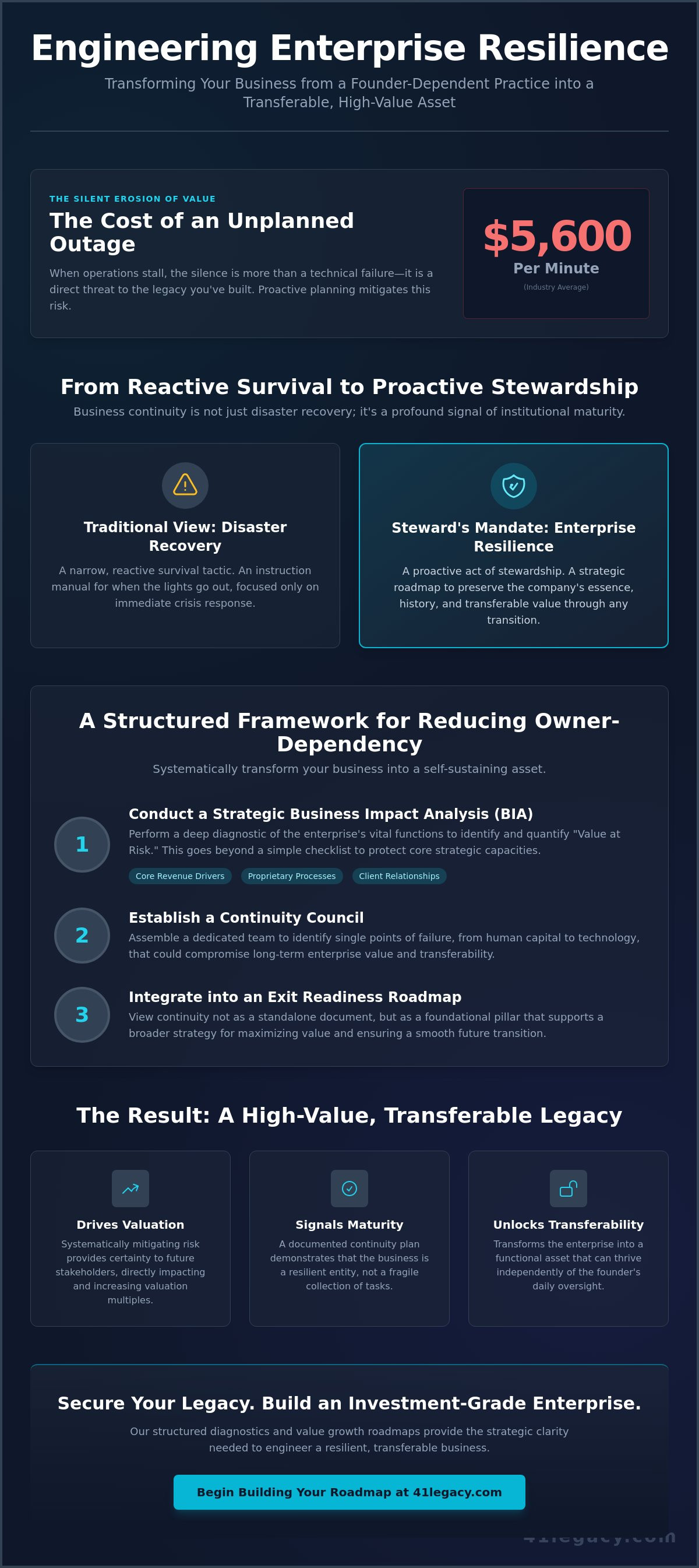
If an unplanned outage costs your organization an average of $5,600 per minute, the silence of a stalled operation is more than a technical failure; it's a direct erosion of the legacy you've spent years crafting. Most founders recognize that their presence is the current heartbeat of the company, yet they live with the quiet anxiety that the rhythm would stop without their daily intervention. You likely agree that a business should be a living entity, capable of breathing on its own. Understanding how to create a business continuity plan is not merely about surviving a storm. It's the sophisticated process of documenting institutional knowledge and engineering resilience so that your enterprise remains a functional, transferable asset regardless of the disruptions that history may present.
This guide provides the strategic clarity needed to transform your operation from a founder-dependent practice into a robust, enduring institution. You'll learn how to build a framework that protects enterprise value by mitigating risks, from human error to evolving regulatory standards like FINRA Rule 4370. We'll examine the essential components of transferability engineering, including diagnostic evaluations and value growth roadmaps. By the end, you'll possess a clear vision for reducing owner-dependency and ensuring your business thrives as a masterpiece of operational excellence, standing firm long after the initial brushstrokes are complete.
Key Takeaways
- Move beyond mere survival by viewing continuity as an act of stewardship that preserves the transferable essence and history of your enterprise.
- Identify the vital organs of your organization, including proprietary processes and core revenue drivers, to protect the strategic capacity of the asset.
- Learn how to create a business continuity plan that systematically reduces owner-dependency, transforming the business into a functional asset that operates without the founder's oversight.
- Establish a Continuity Council to conduct deep enterprise diagnostics, identifying single points of failure that could compromise long-term enterprise value.
- Integrate your continuity strategy into a broader exit readiness roadmap to ensure the business remains a high-value, transferable legacy for future stewards.
Redefining Continuity: From Disaster Recovery to Enterprise Stewardship
Traditional views of Business Continuity Planning often focus on the immediate aftermath of a crisis. This narrow lens views continuity as a mere survival tactic, a set of instructions for when the lights go out. We view it as an act of stewardship. It is the preservation of a company's inner essence and the safeguarding of its history. When you learn how to create a business continuity plan, you aren't just writing an insurance policy. You are documenting the soul of an enterprise. True continuity ensures operational harmony remains undisturbed during transitions, whether those shifts are planned departures or unexpected disruptions.
Sophisticated buyers and successors look for more than just historical cash flow. They seek the quiet confidence that comes from a mature organization. A comprehensive plan acts as a profound signal of institutional maturity. It demonstrates that the business is not a fragile collection of tasks, but a resilient entity capable of thriving through time. By prioritizing this level of preparation, you differentiate between mere survival and the intentional preservation of transferable enterprise value.
The Philosophy of the Transferable Asset
A business that depends on a single person's daily breath is inherently fragile. It possesses limited market attractiveness because the value is tied to an individual rather than the institution. Moving from a "job" to an "investment grade" enterprise requires a shift in perspective. It demands that we extract the wisdom held in the founder's mind and weave it into the fabric of the organization. 41 Legacy specializes in this brand of Transferability Engineering, ensuring that the essence of the work is captured and codified. A Business Continuity Plan is a strategic roadmap for institutional resilience.
Continuity as a Valuation Driver
Risk mitigation is a silent but powerful engine of value. In our experience with Enterprise Diagnostics, we often find a significant "Value Gap" where the potential of a company is hindered by its vulnerabilities. Documented resilience directly impacts valuation multiples by providing a sense of certainty to future stakeholders. When risks are systematically mitigated, the perceived danger of the transition drops. This transforms the owner's role. You are no longer just an operator managing daily fires; you are a steward of a lasting legacy. By addressing these vulnerabilities through structured advisory support at 41 Legacy, you build an asset that commands respect and premium value in any market environment.
Conducting a Strategic Business Impact Analysis (BIA)
To master how to create a business continuity plan, one must first perform a rigorous diagnostic of the enterprise's anatomy. A Strategic Business Impact Analysis (BIA) serves as more than a mere checklist; it's a deep examination of the organization's vital organs. We look beyond the surface to identify the core revenue drivers, proprietary processes, and the delicate client relationships that form the company's heritage. When these elements are compromised, the enterprise doesn't just lose time. It loses the "Value at Risk"—the cumulative worth of its reputation and its future potential.
Determining Recovery Time Objectives (RTO) for value-generating activities is a precise undertaking. It requires a calm assessment of how long a specific strategic capacity can remain dormant before the damage to transferability becomes irreversible. This process also involves evaluating the interdependencies between your internal operations and your professional advisory team. Your attorneys and advisors are part of the protective shell around your legacy; their roles must be clearly defined within the plan to ensure a seamless response when the unexpected occurs. This alignment ensures that the enterprise continues to function as a cohesive, living entity.
Mapping Critical Strategic Capacities
Success in continuity planning lies in the ability to distinguish between urgent administrative noise and true value-driving functions. While Ready.gov's business continuity guide provides a solid foundation for preparedness, a strategic approach looks at the "Strategic Capacity" required to keep your Value Growth Roadmap on track. If a disruption stalls a key initiative, the long-term impact on the enterprise's trajectory can be far more costly than the immediate loss of billable hours. We prioritize the preservation of the momentum you've built over years of dedicated effort.
Quantifying the Impact of Disruption
Disruption creates a silence that can be deafening to potential successors or buyers. By using enterprise diagnostics, we identify the vulnerabilities within your current organizational structure that lead to this operational silence. This isn't just about lost revenue. It's about the "Value Gap" created when a system is too dependent on a single individual or a fragile process. Quantifying this gap helps a steward understand the financial weight of their vulnerabilities. A thorough Strategic Capacity Evaluation can illuminate these gaps, allowing you to strengthen the asset's resilience before a transition becomes necessary.
Mitigating the Founder Trap: Continuity as Owner-Dependency Reduction
The most persistent obstacle to enterprise longevity is often the founder's own shadow. Many owners harbor a quiet belief that the business would simply cease to function without their direct, daily oversight. While this sentiment stems from a place of dedication, it creates a profound structural vulnerability. In the context of Owner Dependency Reduction, a business that cannot breathe without its creator is not an asset; it's a high-stakes job. When considering how to create a business continuity plan, we must look beyond external disasters and address the internal risk of the "Founder Trap."
Identifying "Single Points of Failure" is a clinical necessity for any steward. These vulnerabilities often hide within the leadership and technical tiers, where critical institutional knowledge remains locked in a single mind. We view the process of delegation and documentation not as a loss of control, but as an act of precision engineering. By codifying these processes, you are ensuring the business survives the departure of any single individual. Standard Operating Procedures (SOPs) are the blueprints of your legacy, transforming ephemeral expertise into a permanent, transferable asset.
The Quarterback Approach to Leadership
Effective continuity requires a multi-disciplinary safety net. By coordinating with a trusted circle of CPAs and attorneys, you establish a coordinated advisory team that understands the strategic intent of the enterprise. This approach shifts the burden of "knowing everything" from the owner to a structured system of experts. While the Ready.gov Business Continuity Plan resources offer a broad starting point for risk management, a custom framework empowers your leadership team to act with autonomy. Owner-dependency is the greatest risk to exit readiness.
Institutionalizing Knowledge and Craftsmanship
We believe business processes should be treated with the same reverence as a master artisan treats their tools. Capturing the "essence" of a founder's decision-making process is a delicate task that requires more than just a list of steps. It involves documenting the philosophy and history behind the work. When you understand how to create a business continuity plan that institutionalizes this craftsmanship, you ensure the strategic roadmap is visible to the entire organization. This transparency allows the enterprise to maintain its momentum and aesthetic standard, even when the original visionary is no longer at the helm. This level of clarity is what transforms a company into a timeless institution.
A Structured Framework for Creating Your Continuity Plan
Building a legacy requires more than vision; it requires a structured mechanism for endurance. When you approach the question of how to create a business continuity plan, think of it as a master artisan drafting the blueprints for a cathedral. It's an intentional sequence designed to protect the essence of what you've built. This framework moves beyond the tactical to ensure your enterprise remains a functional, transferable asset regardless of the environment.
- Step 1: Assemble the Continuity Council. True stewardship isn't a solo endeavor. You must gather a circle of key internal leaders and external experts, such as your CPA and attorney, to ensure every facet of the organization is represented.
- Step 2: Perform Enterprise Diagnostics. Conduct a comprehensive risk assessment that looks through the lens of enterprise value. Given that 68% of cloud outages in 2024 were caused by human error, your diagnostics must account for internal vulnerabilities as much as external threats.
- Step 3: Develop Value-Centric Recovery Strategies. Prioritize the restoration of activities that drive transferability. Your recovery efforts should focus on maintaining the strategic capacities that make the business attractive to a future steward.
- Step 4: Formalize Communication Protocols. Establish a clear, polished rhythm for informing stakeholders, clients, and your advisory team. Silence during a transition is a liability; clarity is an asset.
- Step 5: Establish Monthly Implementation Support. A plan is only as strong as its last update. Implementing a rhythm of testing ensures the document remains a living reflection of your current operations.
Step-by-Step Implementation Strategy
Integrating these tasks into your existing workflow is essential for maintaining momentum. By aligning BCP milestones with a Strategic Advisory retainer, you ensure that continuity isn't a one-time project but a consistent discipline. We prioritize the most critical "Value Risks" first, addressing the vulnerabilities that create the largest gaps in your enterprise's health. This approach ensures that every legal and financial document in your archives is harmonized with your long-term vision of resilience.
Testing and Refining the Essence
A static plan is a dangerous liability. It's a frozen snapshot of a world that has already changed. To keep the plan relevant, we utilize tabletop exercises that simulate transitions or disruptions in a controlled, high-altitude environment. These simulations allow the Continuity Council to refine the Value Growth Roadmap based on real-world feedback loops. This process of constant polishing ensures that when a true disruption occurs, the organization responds with the grace and precision of a well-rehearsed ensemble, preserving the history and future of the enterprise.
Integrating Continuity into Your Exit Readiness Roadmap
The true measure of an enterprise's worth is revealed at the moment of transition. Integrating a robust continuity strategy into your exit roadmap is the final, essential act of Transferability Engineering. It ensures that the operational rhythm you've perfected remains steady when the baton is passed to a new steward. When you master how to create a business continuity plan, you're doing more than managing risk. You're polishing the asset for its next chapter. This preparation serves as a profound signal of maturity to future successors, proving that the organization's value is institutional rather than personal.
This alignment with your long-term financial goals is a hallmark of our structured advisory support. We view the business as a living entity with a story that must continue. By codifying your institutional knowledge now, you ensure that the essence of the work is never lost to the progression of time. A business that can thrive independently of its founder is a business that commands a premium. It's the ultimate expression of professional excellence to build an asset that doesn't require your daily intervention to maintain its luster.
The 41 Legacy Diagnostic Approach
We begin with a clinical examination of the organization's health. Our initial assessment identifies the "Value Gap" often caused by fragmented or non-existent continuity planning. By linking these strategies directly to the Enterprise Diagnostic phase, we reveal the hidden vulnerabilities that could stall a successful transition. This diagnostic lens allows us to see where the business is most fragile and where it's most resilient. Understanding how to create a business continuity plan within this diagnostic framework ensures that no strategic capacity is left unprotected. Discover how our Exit Readiness Assessment identifies hidden risks within your current leadership and operational tiers. We help you bridge the gap between where the business is today and the investment-grade enterprise it's meant to become.
Your Legacy as a Transferable Asset
There's a quiet confidence that comes from building something designed to outlast its creator. This is the intersection of technical engineering and creative artistry. When your business operates as a functional, transferable asset, you've fulfilled your role as a dedicated steward. The work is no longer dependent on your daily presence; it's become a masterpiece of operational excellence. It's about preserving the heritage of the company while ensuring its future performance remains uncompromised. We invite you to begin your journey toward strategic clarity and a transferable legacy with a team that values your history as much as your performance.
Securing the Masterpiece: Your Path to a Transferable Legacy
The transition from a founder-led operation to an investment-grade institution is a deliberate act of stewardship. By identifying your vital strategic capacities and systematically reducing owner-dependency, you ensure that the essence of your enterprise remains intact through any disruption. Understanding how to create a business continuity plan is the final, essential step in codifying the institutional knowledge that transforms a business into a lasting legacy. It's the difference between a company that merely survives and one that thrives as a functional, transferable asset.
At 41 Legacy, we approach this process with the precision of a master artisan. Led by a Certified Exit Planning Advisor (CEPA), our structured "Quarterback" advisory model focuses on Transferability Engineering and sustainable value growth. We invite you to secure your company's future with a comprehensive Exit Readiness Assessment from 41 Legacy. By evaluating your current strategic clarity and diagnostic health, you can move forward with the confidence that your life's work is built to endure. Your legacy deserves nothing less than a commitment to perfection.
Frequently Asked Questions
What is the difference between a Business Continuity Plan and a Disaster Recovery Plan?
A Disaster Recovery Plan focuses on the restoration of technical systems and data, while a Business Continuity Plan ensures the entire enterprise remains functional. Think of disaster recovery as the repair of a specific instrument and continuity as the survival of the entire orchestra. Continuity addresses personnel, communication, and strategic capacity during a transition or crisis, preserving the essence of the work.
How often should a business owner update their continuity plan?
You should review and refine your plan at least once per year or whenever a significant shift occurs in your organizational structure. A legacy is not static; it requires consistent polishing to remain relevant. Regular updates ensure that your recovery strategies align with current revenue drivers and the evolving landscape of your industry, keeping the asset investment-grade.
Does a small business really need a formal BCP if the owner is still involved daily?
Formal planning is most critical for small businesses where the owner is deeply involved in daily operations. Without a structured framework, your presence becomes a single point of failure that erodes enterprise value. Understanding how to create a business continuity plan allows you to codify your wisdom, ensuring the business thrives as an independent, transferable asset even in your absence.
How does a continuity plan affect the valuation of my company during an exit?
A robust continuity plan directly increases company valuation by mitigating the risks associated with leadership transitions. Sophisticated buyers offer higher multiples for businesses that demonstrate institutional resilience and operational harmony. By documenting your processes, you prove that the company's success is repeatable and independent of any single individual, which reduces the perceived risk for a successor.
Who should be involved in the creation of a Business Continuity Plan?
Your Continuity Council should include key internal department heads and your circle of external professional advisors, such as your CPA and attorney. This collective approach ensures that every facet of the organization, from operations to finance, is represented in the strategy. Each participant acts as a guardian of a specific strategic capacity, united by a singular vision of institutional perfection.
Can a BCP help reduce my personal dependency on the business operations?
A primary objective of this process is to systematically reduce owner-dependency by institutionalizing your decision-making essence. When you learn how to create a business continuity plan, you're engineering a system where your team can act with autonomy. This shift transforms you from a daily operator into a strategic steward, allowing the business to function as a self-sustaining entity.
What are the most common mistakes owners make when writing a continuity plan?
The most frequent error is treating the plan as a static document that sits forgotten in a digital archive. Owners often fail to conduct tabletop exercises or simulate disruptions, leaving the plan untested in real-world conditions. Another mistake is ignoring the emotional weight of leadership transitions, which can disrupt the operational harmony of the entire team if not addressed with clarity.
How do I integrate my CPA and attorney into the continuity planning process?
Integrate your CPA and attorney by aligning your legal documents and financial strategies with your continuity roadmap. They provide the technical precision needed to ensure that buy-sell agreements and tax structures support the preservation of enterprise value. This multi-disciplinary safety net ensures that every technical detail serves the broader philosophy of building a lasting, protected impact.
Disclaimer
This article is for educational and informational purposes only and does not provide legal, tax, investment, or business brokerage advice. 41 Legacy does not offer M&A brokerage services, legal document drafting, tax preparation, or investment advisory services. Business owners should consult licensed professionals in those disciplines before making decisions related to business transactions, legal matters, tax strategy, or financial planning. All examples are illustrative and may not apply to your specific situation.