
A sophisticated system can make a business harder to transfer if only its founder knows how to use it. That’s why how technology systems impact business value isn’t simply a question of which tools are installed. Owners need to know whether technology investments improve performance and whether essential knowledge and workflows remain concentrated with key people.
The real measure is what the systems make possible. Do they help the business deliver consistent results, produce reliable information, and operate without the owner resolving every exception? This article explains how technology connects to performance, risk, and transferability, and how to spot weaknesses without mistaking new software for lasting value.
We’ll examine practical signs of owner dependence, fragmented information, and inefficient processes, then consider how to prioritize improvements that help the business function beyond its founder. The goal is a clearer view of whether your systems support a durable, transferable enterprise and what to assess before investing further.
Key Takeaways
- Assess how technology supports repeatable performance, clear operating information, and continuity, not just which tools the business owns.
- Understand how technology systems impact business value by examining whether they reduce owner dependency and support operations beyond the founder.
- Before adding software, consider whether your processes, data quality, accountability, and consistent use will allow it to deliver practical benefits.
- Review critical workflows, system ownership, information quality, and continuity to identify technology-related gaps worth addressing.
- Use business diagnostics to help prioritize improvements that strengthen transferability alongside the systems already in place.
How technology systems impact business value: the connection explained
Technology contributes to business value through the work it helps a company perform and the information it makes available. A financial platform may organize invoices and reporting. A customer system may track inquiries and follow-up. Operational tools may support scheduling or inventory, while communication systems help people share decisions and records. Together, these tools, processes, and information flows support core operations.
The distinction matters: software is a tool, not a complete operating system. A platform creates little lasting benefit if employees use it inconsistently, key information remains elsewhere, or only one person knows how to complete essential tasks. Reliable systems connect the tool to a clear process, defined responsibilities, and information others can understand and use.
Which systems count as business technology systems?
There is no universal technology stack every business needs. The right systems depend on how the company serves customers, delivers work, manages finances, and shares information. What matters is how well the pieces support connected workflows. For example, a customer request should have a clear path from initial contact to assigned work and follow-up, with responsibility visible to the people involved.
Review the handoffs as well as the platforms. Where is information entered, who maintains it, and how does it reach the next person? Clear answers help distinguish a functioning system from a collection of disconnected tools.
How do systems connect to enterprise value?
The connection is indirect. A documented process can help employees complete work consistently; dependable records can make operating results easier to review; and clear responsibilities can reduce dependence on the owner’s memory or intervention. These conditions support continuity and give owners and their professional advisors a more useful basis for decisions. They don’t guarantee stronger financial results, but they can make performance and its underlying processes easier to understand.
This is the practical link between technology and business value: systems matter when they help the company produce repeatable performance without relying on one person to hold the operation together. Wikipedia’s overview of Business value of information technology also describes the relationship between information technology, business processes, and organizational goals.
For owners considering broader value-growth priorities, technology should be assessed alongside other drivers of enterprise strength, not treated as a standalone investment. The useful question isn’t simply whether the business has modern software. It’s whether its systems make day-to-day performance more visible, consistent, and transferable.
How technology systems support performance, resilience, and transferability
Reliable systems help a business deliver work consistently, even as responsibilities shift between people or operating periods. A documented workflow can clarify what happens after an order arrives, who approves an exception, and where the final record is kept. Dependable reporting can also give owners a clearer view of operating activity, though information alone doesn’t guarantee better decisions or results.
Systems strengthen transferability when routine work can continue without constant owner intervention. That requires more than a written procedure or a shared platform. People need to know their responsibilities, have appropriate access to the information they need, and understand how to carry work forward when a colleague is unavailable.
Can systems reduce owner dependency?
Start by identifying work that pauses unless the owner is involved. This may include approving routine decisions, recalling customer preferences, locating key records, or explaining an unwritten process. Documenting the steps and clarifying who can act within agreed boundaries helps make responsibility visible. A practical companion is “What Is an SOP in Business?”, which explores how standard operating procedures can capture repeatable work.
Documentation should reflect how the work actually happens, not an idealized process no one follows. Review it with the employees who perform the work, confirm that records are accessible to the appropriate people, and note decisions that still require the owner’s judgment. This reveals where knowledge has been transferred and where dependency remains.
How can systems support continuity and risk awareness?
Continuity is a matter of preparation, not certainty. Consider whether critical process information has a defined backup, who is responsible for maintaining it, and whether access is appropriate for each role. Review how the business would locate essential records or reassign work if a key person were unavailable. These questions can expose operational gaps without assuming a particular technology or security capability.
Cybersecurity and continuity deserve deliberate review, but no system can guarantee that a disruption or loss will not occur. The practical objective is to understand dependencies, assign ownership, and reduce avoidable uncertainty. Technical safeguards should be reviewed with the relevant technology professionals; the business-level question is whether responsibilities and continuity expectations are clear.
This is one dimension of how technology systems impact business value: systems can make performance less dependent on individual memory and more understandable to the people responsible for sustaining it. If owner dependency or continuity gaps are difficult to prioritize, 41 Legacy’s enterprise value advisory can help owners assess these issues within the broader strength and transferability of the business.
Does technology alone increase business value? The limits owners should understand
No. Purchasing software doesn’t automatically strengthen enterprise value. A new platform may offer useful features, but value depends on whether the business adopts it, fits it to real workflows, maintains dependable information, and assigns clear responsibility for using it. The relevant question isn’t what the software can do in theory. It’s what the business consistently does better because of it.
Technology supports value when people use it to produce measurable, repeatable business outcomes. Those outcomes might include more timely reporting, fewer avoidable handoff errors, or clearer ownership of customer follow-up. They should be observable in the work itself, not assumed from the purchase.
Why can a new system fail to improve business performance?
A system can miss the mark if the business hasn’t defined the constraint it needs to address. For example, a company seeking better visibility into customer follow-up may add a tool without agreeing on who records each interaction or when records should be updated. The software is in place, but the underlying process remains unclear.
Inconsistent use can also weaken the information a system produces. If employees keep separate records or enter the same details differently, reports may be incomplete or difficult to trust. Implementation takes time, too: people must learn new routines, existing processes may need adjustment, and employees may rely on a specialist to resolve issues. These demands don’t mean a system is a poor choice, but they belong in the decision alongside its expected benefit.
What matters more than the software brand?
Prioritize the operating conditions that allow a system to serve the business. Before committing to a tool or expanding its use, consider:
- Workflow fit: Does it support an essential process as the work actually happens?
- Clear ownership: Who maintains the system and ensures information is entered consistently?
- Dependable information: Can people use its records to understand what has happened and what needs attention?
- Practical adoption: Can the relevant employees use it as part of their routine responsibilities?
- Manageable dependencies: Does the business understand where specialist help is needed and how that knowledge is accessed?
The right setup varies with a company’s size, operating model, and needs. A larger or more complex platform isn’t automatically better; a simpler arrangement may be more useful if it supports essential work reliably. To assess how technology systems impact business value, look past the brand and examine the fit between people, process, and information. That view helps owners distinguish a technology purchase from an operating improvement that can endure.
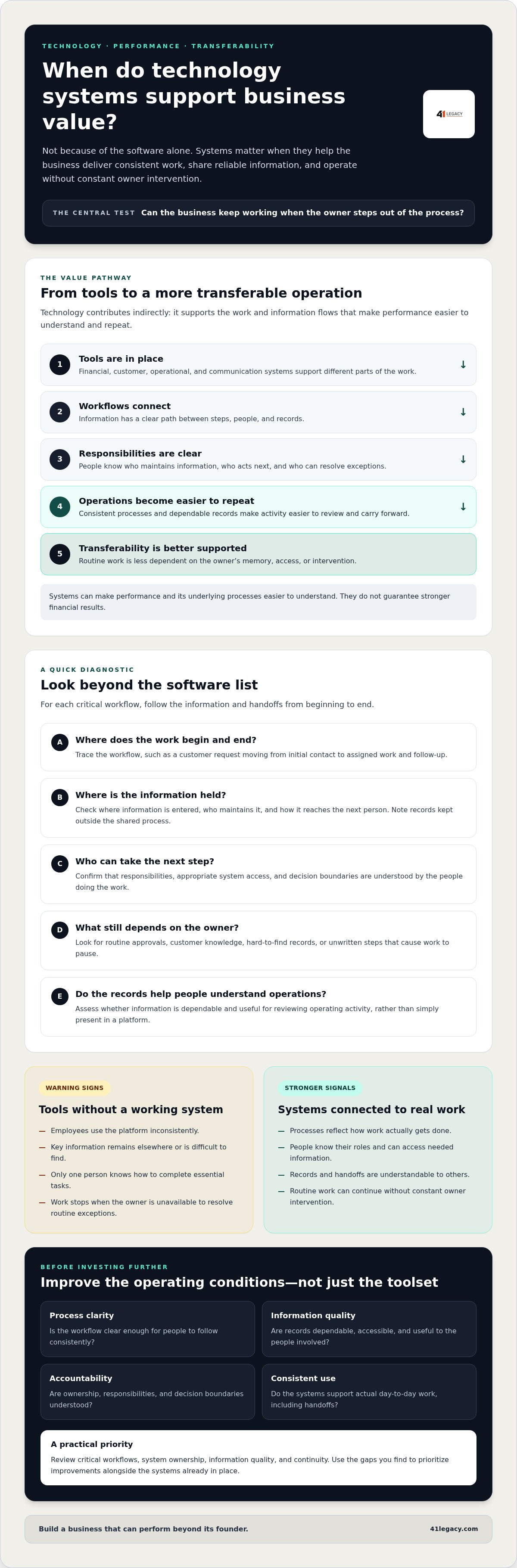
How to assess whether your technology systems support business value
A practical review looks beyond software features to how essential work moves through the business. Use these five steps to identify what supports dependable operations, where knowledge is concentrated, and which gaps deserve attention.
- Map critical workflows. Trace a few essential activities from start to finish, such as fulfilling a customer request or closing the books. Note handoffs, repeated manual steps, and points where work waits for a decision.
- Identify system owners. For each workflow, clarify who maintains the relevant tools and records, who is responsible for the work, and who can step in if that person is unavailable.
- Inspect information quality. Check whether responsible people can find current, consistent information for routine decisions. Note duplicate records, missing details, or information kept outside the systems others rely on.
- Assess continuity. Ask whether essential work can continue if the owner or a key employee is unavailable. Consider whether access, process knowledge, and responsibilities are clear enough for someone else to carry the work forward.
- Prioritize gaps. Rank issues by their effect on essential operations, continuity, and business goals. Separate urgent process or access concerns from optional upgrades.
Keep the review grounded in the business’s existing information. Depending on the workflow, relevant measures might include time to complete a task, work waiting for approval, missed handoffs, or records requiring correction. Track measures already available and compare them over time; don’t assume an outside benchmark applies or set a target without context.
Three questions can help reveal where to look more closely:
- Which activities rely on informal knowledge, repeated manual work, or individual approvals?
- Can the people responsible access clear, current information for routine decisions?
- Are critical workflows documented, maintained, and understood by more than one person?
Prioritization should reflect consequences, not novelty. A process that stops when one person is away may warrant attention before a feature upgrade that offers convenience but doesn’t address a core business need. Technical questions about system capability or access should be discussed with qualified specialists. Strategic questions about owner dependency, continuity, and enterprise priorities can be considered with the owner’s existing advisors.
This review can also inform a broader assessment of transferability and enterprise readiness. For owners who want to connect system-related gaps with wider business priorities, explore 41 Legacy’s strategic advisory approach.
Build technology systems into a more transferable business
Technology systems matter when they help the business operate dependably and make its work understandable, not simply because the company has invested in software. Clear processes, reliable information, and defined responsibilities can make routine work easier to sustain beyond the founder. In that sense, how technology systems impact business value is part of a broader question: can the business continue to perform when ownership or responsibilities change?
System-related gaps should be considered alongside other factors that shape transferability. If reporting depends on manual work, key processes live in one employee’s memory, or routine approvals bottleneck with the owner, those conditions may point to broader operating risks. Diagnostics can help clarify where visibility, process continuity, or reduced owner dependency should become a priority.
How can systems fit into an enterprise value roadmap?
System findings are most useful when tied to business objectives rather than turned into a standalone technology shopping list. If a priority is improving operating visibility, for example, first clarify what information decision-makers need, who is responsible for maintaining it, and where the current process breaks down. Then the owner can work with qualified technology specialists on technical questions while coordinating strategic priorities with existing professional advisors.
Owners considering a broader transition can also explore “Exit Planning for Business Owners” for related context. The central principle is alignment: technology decisions should support the future operating model and business goals, not distract from them.
What does a strategic advisory process contribute?
Enterprise diagnostics help establish a clearer view of current conditions and potential value gaps. A Value Growth Roadmap can then organize priorities, sequence improvements, and clarify accountability. The aim is not to prescribe a particular platform or promise a financial result. It’s to help the owner make informed decisions about the business as a whole and build an asset that can operate with less dependence on the founder.
41 Legacy provides strategic advisory and monthly implementation support to help owners coordinate priorities and follow through alongside their existing advisors, such as CPAs and attorneys. It does not install or implement technology systems. Technical selection and implementation remain matters for appropriate technology professionals.
If you’re assessing whether your business is prepared for a transition, an Exit Readiness Assessment can help frame technology-related questions within the wider picture of enterprise strength and transferability.
Build a business that can operate beyond you
Technology supports enterprise value when it helps the business perform consistently, makes important information easier to understand, and reduces reliance on the owner’s memory or intervention. Buying software alone doesn’t create those conditions. Clear workflows, dependable information, and shared responsibility give systems their practical value.
To assess how technology systems impact business value, look at whether essential work can continue when a key person is unavailable and whether current systems support the business’s broader goals. Treat technology gaps as part of enterprise readiness, not as a separate shopping list.
Structured enterprise diagnostics can help clarify current conditions and potential value gaps. A Value Growth Roadmap and strategic advisory support can help owners prioritize improvements and coordinate implementation with their existing advisors. This is strategic guidance, not technology installation, and no system alone guarantees a stronger outcome.
For a broader view of your business’s readiness and transferability, explore 41 Legacy’s Exit Readiness Assessment. With clear priorities and steady action, you can build an enterprise better prepared to thrive beyond its founder.
Frequently Asked Questions
How do technology systems impact business value?
Technology systems can support business value when they help a company operate consistently, preserve useful information, and reduce dependence on one person. How technology systems impact business value depends on how well the systems fit actual workflows and whether employees use them reliably. Assess operational outcomes, continuity, and transferability rather than counting tools. Software purchases alone don’t guarantee growth or a higher valuation.
Does investing in new technology increase a company’s value?
Not automatically. New technology may support efficiency, visibility, or continuity, but those benefits depend on suitable processes, employee adoption, reliable information, and clear accountability. A tool that adds complexity without addressing a real business need may not improve performance. Before investing, define the operational problem, decide how you’ll assess progress, and consider whether a process improvement or better use of existing systems could address it.
Can technology systems reduce owner dependency?
They can help when processes, information, and responsibilities are accessible beyond the owner. Documented workflows and appropriately managed system access may allow others to carry out routine work and make informed decisions. Technology alone can’t replace leadership or judgment. Identify where the owner remains essential, then address process, delegation, and system gaps together. The goal is to make routine operations less reliant on the founder’s memory or intervention.
What technology systems should a small business assess?
Start with systems that support essential work, such as financial records, customer information, operations, and communication. The right priorities depend on how the company operates; there isn’t one set of platforms every business needs. Assess whether information is dependable, responsibilities are clear, and critical workflows can continue if someone is unavailable. For system-specific security or configuration questions, consult qualified technical specialists.
How can owners tell whether business systems are working well?
Look beyond whether a system is installed. Ask whether employees use it consistently, whether it supports important workflows, and whether decision-makers can access current, relevant information. Review operating measures the business already tracks, and note where manual work, duplicate records, or individual knowledge create friction. Avoid unsupported industry benchmarks. Compare results with the company’s objectives and its own starting point to judge whether the systems are useful.
How do business systems affect transferability?
Business systems may support transferability by making essential processes more understandable, repeatable, and less dependent on the founder. Clear records and defined responsibilities can help others oversee operations and understand how work gets done. They don’t guarantee a successful transition. Consider systems alongside leadership depth, documented processes, customer relationships, and other factors that influence whether the business can operate beyond its current owner.
Should a business owner assess technology before exit planning?
It can be useful to understand how systems support daily operations and where important knowledge or access is concentrated. This review is one part of broader exit readiness, not a substitute for legal, tax, technical, or other specialized advice. Owners can identify strategic questions, then coordinate qualified specialists and existing advisors around priorities that support the company’s readiness for a future transition.
Disclaimer
This article is for educational and informational purposes only and does not provide legal, tax, investment, or business brokerage advice. 41 Legacy does not offer M&A brokerage services, legal document drafting, tax preparation, or investment advisory services. Business owners should consult licensed professionals in those disciplines before making decisions related to business transactions, legal matters, tax strategy, or financial planning. All examples are illustrative and may not apply to your specific situation.