Transferability & Owner Dependency
Exit Planning vs. Succession Planning: Engineering a Transferable Legacy
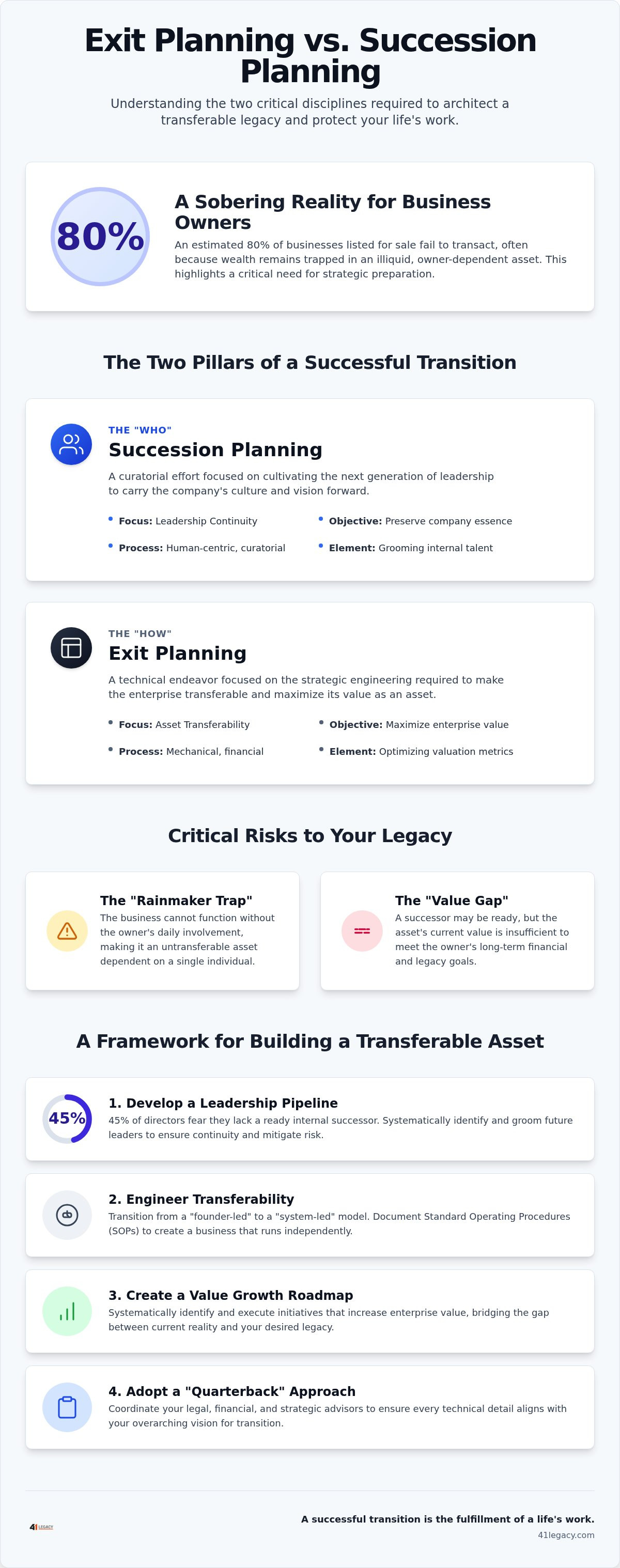
An estimated 80% of businesses listed for sale fail to transact, a sobering reality for those who've spent decades in the pursuit of excellence. For the connoisseur of industry, the realization that wealth remains trapped in an illiquid asset is often the first sign that the architecture of the enterprise requires a more surgical approach. You likely recognize that your business is more than a source of income; it's a repository of history, and protecting that legacy requires a clear understanding of exit planning vs succession planning.
We believe that true stewardship requires a mastery of both the human and the mechanical aspects of a transition. You'll discover how to harmonize the cultivation of a leadership pipeline with the rigorous engineering of enterprise value. We'll preview the roadmap for reducing owner dependency and maximizing the health of your asset, ensuring it remains a transferable masterpiece that thrives long after your final day as its primary guardian. By aligning these two disciplines, you ensure the transition is not merely a transaction, but the fulfillment of a life's work.
Key Takeaways
- Distinguish the human element of leadership continuity from the mechanical engineering of value to master the nuances of exit planning vs succession planning.
- Identify and mitigate the "Rainmaker Trap" through enterprise diagnostics that ensure your business thrives as a living entity independent of your daily involvement.
- Utilize a Value Growth Roadmap to systematically bridge the gap between your current asset value and the financial requirements of your enduring legacy.
- Adopt a "Quarterback" approach to transition, coordinating your legal and financial advisors to ensure every technical detail aligns with your overarching strategic vision.
The Semantic Divide: Defining Exit Planning vs. Succession Planning
Precision is the hallmark of any master artisan. In the architecture of an enterprise, that precision begins with language. Many owners conflate two distinct disciplines, a mistake that often results in strategic stagnation. Understanding the difference between exit planning vs succession planning isn't a mere academic exercise; it's the foundation of protecting your life's work. Clarity is the first step toward a lasting legacy.
Succession is a curatorial effort focused on the "who." It's the deliberate process of identifying who will carry the torch of leadership. Conversely, exit planning is a technical endeavor focused on the "how" and "how much." It's the strategic engineering required to transfer ownership and realize the maximum value of the asset. When these terms are treated as synonyms, a "Value Gap" often emerges. You might have a willing successor but an asset that's too dependent on your daily involvement to be truly transferable. The interplay of exit planning vs succession planning determines whether your transition is a graceful evolution or a chaotic disruption.
We view the business owner not just as a manager, but as a steward. A steward's duty is to ensure the living entity of the business can thrive independently. This requires building a transferable asset that possesses its own inherent strength. Protecting your life's work requires the kind of Strategic Advisory that looks beyond the immediate horizon to the enduring essence of the firm.
The Scope of Succession
Leadership continuity is the primary objective of this phase. Succession planning involves identifying and grooming internal candidates to carry the company's culture forward. This process carries significant emotional weight, particularly when family or long-term employees are involved. It's a curatorial effort to ensure the company's essence remains intact while the hands on the wheel change. Without a clear pipeline, even a profitable business risks operational collapse the moment the founder departs.
The Scope of Exit Planning
Exit planning is the rigorous engineering of the asset's transferability. The goal is to create a business that runs independently of the founder, a feat that requires optimizing the financial metrics that drive valuation multiples. We call this Transferability Engineering. It ensures the business transfer aligns with the owner's personal financial goals. By focusing on enterprise value growth, we help owners bridge the gap between their current reality and their desired legacy. It's about creating an asset that any connoisseur of industry would be proud to own.
Succession Planning: Cultivating the Next Generation of Leadership
Succession is a curatorial process. It is the deliberate act of identifying the inner essence of your organization’s culture and ensuring it survives the transition of leadership. While many view this as a simple human resources task, we see it as a high-stakes preservation of legacy. True stewardship requires you to look beyond the current operational needs to identify the individuals capable of carrying your vision into the next century. This human element is the vital counterpart to the technical engineering found in the debate of exit planning vs succession planning.
The most significant threat to a business's longevity is the "Rainmaker Trap." This occurs when the founder remains the sole engine of revenue and the primary repository of institutional knowledge. If the enterprise cannot breathe without your daily presence, it's not yet a transferable asset. Statistics from iMocha (March 2026) reveal that 45% of corporate directors are concerned they will not have even one internal successor ready for the CEO role. This lack of a leadership pipeline creates a fragile structure. To build a lasting impact, you must develop talent not just for functional tasks, but for strategic decision-making. This shift requires moving from a "founder-led" model to a "system-led" model where excellence is a repeatable mechanical standard.
Standard Operating Procedures (SOPs) serve as the polished gears of this system. They provide the technical precision required for your team to operate with a high sheen of professionalism. When your processes are documented with surgical clarity, the business begins to function as a living entity independent of its creator. A thorough Strategic Capacity Evaluation can help determine if your current team is prepared to uphold these standards once the keys are handed over.
Identifying Strategic Capacity
Evaluating your management team requires an objective diagnostic lens. There is a profound difference between a functional manager who executes tasks and a strategic successor who can navigate future complexities. Enterprise diagnostics often reveal leadership gaps that remain hidden during periods of stability. You must determine if your current leadership has the capacity to engineer the next chapter of growth or if they are merely maintaining the status quo.
The Transition of Authority
Handing over the "keys" to the enterprise should be a phased, unhurried process. This transition of authority allows for the reduction of owner dependency while maintaining a steady rhythm of corporate governance. By implementing a structured development plan, you ensure that the successor is not just assuming a title, but is fully integrated into the strategic heart of the business. This careful cultivation ensures that the transition feels like a natural evolution rather than a disruptive event.
Exit Planning: Engineering the Transferability of the Enterprise
Exit planning is not a transaction; it is an act of meticulous engineering. While succession focuses on the human element of leadership, exit planning addresses the mechanical integrity and financial vitality of the asset itself. We refer to this process as Transferability Engineering. It is the art of making a business attractive to a connoisseur buyer who seeks a legacy rather than a job. In the ongoing dialogue of exit planning vs succession planning, the former ensures the enterprise can stand alone as a self-sustaining entity.
A business that cannot run without its founder is a liability, not an asset. It represents a collection of tasks rather than a transferable masterpiece. True exit readiness rests on two distinct pillars: market attractiveness and internal readiness. Your industry might be in high demand, but if your internal systems are brittle or your revenue is tied to your personal relationships, the valuation will suffer. We work with you to identify the "Value Gap," which is the difference between what your business is worth today and its potential value if optimized for a transition. Closing this gap requires a Value Growth Roadmap, a strategic guide that refines every gear within the corporate machine.
Enterprise Diagnostics and Valuation
Understanding your current position requires a formal diagnostic that looks beyond the surface of the balance sheet. We search for "Red Flags" that might decrease valuation multiples during due diligence, such as heavy customer concentration or a lack of documented intellectual property. The Exit Readiness Assessment serves as the diagnostic foundation for all future growth initiatives. By identifying these vulnerabilities early, we can address them with surgical precision before they become obstacles to your transition. This technical clarity ensures that the eventual transfer is seamless and your equity is protected.
Maximizing Transferable Value
Building value requires a simultaneous focus on EBITDA growth and risk reduction. High earnings lose their luster if the risk of those earnings evaporating is too high for a successor. Recurring revenue streams and a diversified customer base are the hallmarks of a resilient, high-value enterprise. We refuse to settle for anything less than a successful, high-value transition. By engineering these strengths into the core of your business, we create an asset that thrives independently of any one individual. This is the ultimate goal: ensuring your life's work survives as a lasting legacy in new hands.
Bridging the Value Gap: Where Personal and Business Plans Converge
A life’s work is rarely confined to the four walls of an office. It is an expression of personal values and a vehicle for a family's future. To protect this essence, the owner must align the living entity of the business with their personal heritage goals. This is the precise point where the technical nuances of exit planning vs succession planning converge. While succession ensures the right hands take the wheel, exit planning ensures the harvest is sufficient to fund the next chapter of your story.
Owners often face two distinct voids: the Wealth Gap and the Value Gap. The Wealth Gap is the distance between your current net worth and the amount required to maintain your lifestyle post-transition. The Value Gap is the difference between what your business is worth today and its potential value if engineered for maximum transferability. Bridging these gaps requires strategic clarity that can only be achieved when your CPA, Attorney, and Financial Planner are in the same room, operating under a unified vision. We act as the "Quarterback" in this process, ensuring that the technical precision of your legal and tax advisors aligns with your overarching legacy goals.
The Role of Strategic Advisory
Moving beyond theoretical discussion requires a commitment to structured implementation. It isn't enough to have a plan; you must have the discipline to execute it. Our Strategic Advisory provides the monthly support necessary to ensure your Value Growth Roadmap stays on track. This ongoing coordination reduces the "noise" of conflicting advice from uncoordinated professionals, allowing you to focus on the high-level stewardship of your enterprise. We provide the steady, unhurried guidance required for a transition of this magnitude.
Protecting the Legacy
Ensuring the transition preserves the essence of what was built over decades is a curatorial responsibility. We utilize Strategic Capacity Evaluation as a tool for legacy protection, assessing whether the business can maintain its high sheen under new leadership. Every decision we make is aligned toward maximizing exit readiness and the long-term health of the asset. By viewing the business as a transferable masterpiece, we ensure that the transition is not an end, but a sophisticated evolution of the work you've spent a lifetime perfecting.
The 41 Legacy Framework: Coordinating Strategy and Heritage
Our mission is rooted in a profound reverence for the work you've spent a lifetime building. We exist to solve the silent crisis of untransferable assets, where wealth remains trapped in a business that cannot survive its founder. Protecting the essence of your enterprise requires more than just technical skill; it requires a unified vision. The tension between exit planning vs succession planning often leaves owners paralyzed by conflicting advice from disparate specialists who don't see the whole picture. We believe your legacy deserves a more harmonious approach.
We assume the role of the "Quarterback," a singular point of coordination for your CPA, Attorney, and Financial Planner. This authoritative oversight ensures that every technical detail, from tax mitigation to legal structure, aligns with your overarching heritage goals. Our process begins with Enterprise Diagnostics, a surgical evaluation of your current enterprise value. This isn't a surface-level glance at the books. It's an unhurried, deep-dive into the mechanical integrity of your firm. From this diagnostic foundation, we craft a Value Growth Roadmap, a custom-produced path designed to bridge the gap between your current reality and a successful, high-value transition.
Implementation with Precision
A plan without disciplined execution is merely a theoretical exercise. We provide monthly implementation support to ensure your professional team moves in perfect harmony toward a common objective. This rhythmic coordination reduces the noise of conflicting opinions and keeps the focus on building a transferable asset. We refuse to settle for a business that remains dependent on its owner. Taking the first step with 41 Legacy is the definitive act of securing your enterprise value and ensuring your life's work remains a polished masterpiece for the next generation.
Your Next Strategic Step
The journey toward a lasting legacy begins with an initial assessment of market attractiveness and internal readiness. These two pillars determine how a connoisseur buyer or a strategic successor will perceive the health of your asset. By reducing risk through structured, authoritative advisory, we move your business from a state of owner-dependency to a state of enterprise-strength. This is how you build a legacy that survives and thrives beyond your daily involvement. It's about ensuring the story of your business continues with the same dedication to excellence that you've always maintained.
The Architecture of an Enduring Transition
True stewardship requires a dual focus on the human heart of the enterprise and its mechanical value. You've explored how succession planning preserves the cultural essence through leadership while exit planning builds the structural integrity that makes the business a transferable asset. Mastering the nuances of exit planning vs succession planning ensures your departure is a graceful evolution rather than a fracture in your legacy. It's the difference between leaving a vacancy and bequeathing a masterpiece.
Under the CEPA leadership of 41 Legacy, we act as the strategic quarterback for your professional advisory team. We ensure every technical detail from your CPA and Attorney aligns perfectly with your long-term vision. Through a structured Value Growth Roadmap, we help you eliminate owner dependency and maximize the health of your enterprise. Your life’s work deserves a future that reflects the precision and passion you’ve poured into it. Secure your business legacy with an Exit Readiness Assessment and begin the meticulous work of engineering an enduring impact.
Strategic Guidance: Frequently Asked Questions
What is the main difference between exit planning and succession planning?
Succession planning focuses on the "who" by identifying and grooming future leadership, while exit planning addresses the "how" and "how much" through the strategic engineering of ownership transfer. While they're often conflated, the distinction between exit planning vs succession planning is critical for protecting an enterprise’s legacy. One ensures the culture survives; the other ensures the asset’s value is maximized and transferable to a connoisseur buyer who values excellence.
Can my current CPA or attorney handle my exit planning needs?
While your CPA and attorney are vital specialists for tax and legal structures, they often operate in silos without a unified strategic roadmap. Exit planning requires a Certified Exit Planning Advisor (CEPA) to act as a quarterback, coordinating these professionals to ensure their technical work aligns with your ultimate heritage goals. This integration prevents conflicting advice and ensures every gear of the transition moves in harmony toward a successful outcome.
When is the best time to start exit planning if I am not ready to sell?
The ideal time to begin is three to five years before your anticipated transition. This window allows for the unhurried implementation of a Value Growth Roadmap, which is necessary to engineer transferability and close any existing value gaps. Starting early transforms the business from a source of income into a high-sheen, transferable asset that can thrive independently of your daily involvement, regardless of when you choose to exit.
Does exit planning involve brokerage or selling my business?
Exit planning is a strategic advisory process, not a brokerage or transaction service. We don't represent you in a sale or act as a business broker; instead, we focus on Enterprise Diagnostics and Transferability Engineering. Our goal is to prepare the asset so it's inherently attractive and ready for a successful internal or external transfer. We provide the architectural guidance needed to ensure the enterprise is a masterpiece of efficiency.
How does reducing owner dependency increase my business’s value?
Reducing owner dependency increases value by lowering the "key person risk" that often devalues an enterprise during due diligence. A business that functions as a living entity, independent of its founder, commands a higher valuation multiple because its cash flow is predictable and sustainable. When systems and teams operate with mechanical precision, the asset becomes a self-sustaining entity rather than a personal liability, making it far more attractive to successors.
What is an Exit Readiness Assessment and why is it necessary?
An Exit Readiness Assessment is a comprehensive diagnostic tool used to evaluate both the attractiveness of your business to the market and your internal readiness for a transition. It serves as the essential starting point for identifying "Red Flags" that could jeopardize a transfer. By revealing these vulnerabilities with surgical clarity, we can prioritize the improvements needed to protect your life's work and ensure the business is prepared for scrutiny.
What is the "Value Gap" in business planning?
The "Value Gap" represents the difference between the current valuation of your business and the net proceeds you require to fund your next chapter. Identifying this gap is a central component of exit planning vs succession planning. By quantifying this distance, we can create a structured roadmap to grow the enterprise’s worth. This ensures your harvest is sufficient to support your personal heritage goals and maintain your lifestyle post-transition.
How does 41 Legacy coordinate with my existing financial advisors?
We utilize a "Quarterback" approach to coordinate with your existing CPA, Attorney, and Wealth Manager, ensuring all professional advice is synchronized. Instead of you managing conflicting opinions, we provide a unified strategic vision that directs their technical expertise. This monthly implementation support ensures that the transition process remains unhurried, logical, and focused on the long-term health of the enterprise. We ensure every specialist moves in harmony toward your vision.
Disclaimer
This article is for educational and informational purposes only and does not provide legal, tax, investment, or business brokerage advice. 41 Legacy does not offer M&A brokerage services, legal document drafting, tax preparation, or investment advisory services. Business owners should consult licensed professionals in those disciplines before making decisions related to business transactions, legal matters, tax strategy, or financial planning. All examples are illustrative and may not apply to your specific situation.